Categories
Autism autism diagnosis Uncategorized

So, you’ve just been diagnosed autistic!

“Please find attached your assessment report. As we have discussed, the report is written in a diagnostic format, focusing on aspects of you as opposed to the whole of you and your life story thus far”, stated the follow up email, from the follow up appointment, from the clinician who was part of the multidisciplinary team that assessed me for autism….

It was many years ago that I attended my assessment follow up, but I still recall the nauseating anxiety as the ‘big reveal’ day approached. I knew I was autistic, my child was autistic and I’m so like them, I HAD to be autistic surely? But what if they got it wrong? What if my gender, my past psychiatric history, those traumatising life events I’d experienced, got in the way and overshadowed my innate neurology?

My follow up appointment confirmed a diagnosis of autism (level 2). Additional sensory processing difficulties were also noted, along with my past history of anxiety, depression and trauma. The report gave the opinion that some of my previous psychiatric labels were likely to be misdiagnoses and argued that some of my mental health symptoms might be better understood in the context of autism and sensory processing differences.

So how did it feel to finally get this diagnosis of autism? In fact it was the 22nd diagnosis I’d received that is listed in the Diagnostic and Statistical Manual of Mental Disorders (DSM-5). Well, I felt ‘kind of something’ that I couldn’t quite describe – but this is normal for me, my autistic interoceptive experiences are often difficult to locate, label and explain. (Interoception is our sense system that picks up and processes body signals including pain, emotions, tiredness, hunger etc etc. Like our other sense systems, autistic people often experience sensory input differently – input may be heightened or muted, distorted, fragmented, delayed, synaesthetic, or otherwise different to that of people who are not autistic.)

Other newly diagnosed people express a whole range of human emotions when first diagnosed, including feeling nothing at all; feeling something intense; feeling validated, vindicated, relieved, terrified, angry, scared, joyful; or a few or all of these emotions; or something else entirely. Each person’s experience will be as unique as they are. There is no “right way” to feel or process the information that you are autistic.

I just received an autism diagnosis, so why do I feel bad?

Whilst a diagnosis of autism may be validating and a relief, it can feel painful to listen to or read a list of what you find difficult. Afterall, the diagnostic criteria is largely a list of deficits – medics don’t diagnose conditions based on an individual’s strengths!

It may hurt deeply to hear loved ones describe you in ways that feel derogatory or that misunderstand your motives. An assessment report or feedback from a clinical team may feel harsh and intense and I recall feeling ashamed of how much I struggle and how often (I perceive) I have ‘failed’. My assessment report sets out my challenges in black and white – unequivocal, harsh, embarrassing, dispiriting. My report states: “Emma manages daily life exceptionally well despite her impairments, she works hard to compensate for her difficulties which prevent them being even more significant than they are.” It felt good to read that my efforts were recognised – virtually all autistic people I have met and worked with, put in huge amounts of effort to get by and survive in a world that so often feels alien and hostile towards our neurotype. I amaze myself that I can keep going sometimes!

It was important to recognise that my assessment report was a synopsis of how I met the diagnostic criteria for autism. My achievements weren’t relevant. My efforts weren’t relevant. My exhaustion from doing my best wasn’t relevant. I have written more about the diagnostic criteria in other blogs . I like to think about my autism assessment like I do the car driving test – an artificial situation that you hope to do only once; that is largely dependent on your performance on the day, that scrutinises only specific areas, and is largely irrelevant to how you actually drive the rest of the time.

On receiving my typed report, I immediately noted a few (minor) inaccuracies that screamed from the pages. I recognise now that I was a simply one human, being assessed by other humans, and the assessor’s interpretation of situations I’d described was as affected by their biases as I am by my biases. It felt difficult though, when reading certain aspects of the report which led to those all-familiar feelings of being misunderstood. Of course, my eagle eyes were working at their sharpest when reading my report, on account of the expectation and anxiety that sharpens your senses and increases your vigilance when under threat – in fact, like all animals in a survival situation, I was tuned in to perceived threats and unable to pick up on cues of safety – and don’t think any typos escaped my keen observation! I’d recommend to anyone receiving the outcome of their assessment, to structure your time in the subsequent days so that you can do whatever self-care works for you and that will help with processing all the information. I have written about autistic self-care in other blogs.

Several years later, I can read my assessment report and feel very little. It doesn’t trigger me, and I have had time to process its contents in my own way. Processing, as the name suggests, is a process! I have thought and felt a variety of things about my diagnosis over the years, and no doubt will continue to do so.

Why did my new diagnosis of autism feel so good?

Quite simply, because I felt seen for who I am. For me, a person with multiple psychiatric diagnoses, some accurate, some questionable, my autism diagnosis explained how I experience the world and offered me a lens through which to revisit every life experience I’d had. My diagnosis made sense. It felt right – and as someone who likes things to be accurate, this was hugely important. My previous diagnoses had never felt 100% right. Sure, some of them resonated – anxiety and depression, for instance – they explained ‘what’ was going on, but not ‘why’ I kept finding myself in the midst of them. Other past psychiatric diagnoses seemed completely off target and almost the opposite of my lived experience. My autism diagnosis meant I felt validated. I almost felt like shouting to the world, “see, this is why I find everything so bloody difficult!”

Now that the outcome is sinking in:

It is normal to think and feel differently about your diagnosis as time moves on. Some people may never feel anything significant about their diagnosis. Other people may wish for the diagnosis to be taken away. Expectations about future support and understanding following diagnosis may be realised – or sadly as is so often the case, there is little support out there unless you are in crisis.

Here are some questions and scenarios that newly diagnosed people may ask or share, and some responses (responses are based on my personal and professional experience and are not recommendations).

Should I tell my family/my school/my workplace?

It’s up to you! Some people feel a need to tell the world they are autistic but there is no obligation to. You may choose to tell no-one. You may decide to share your diagnosis on a case by case basis. You might decide to blog about it and tell the world, like I did!

I’ve been told by friends/family/colleagues that I don’t seem autistic…

This is unsurprising in some ways because often people only learn about autism through the media and stereotypes. People may be comparing you to the only other autistic person they know e.g. a friend’s child. They may be unaware of how much time you spend masking in order to stay safe. There is no right way to respond to this situation and it might help to join online communities or find local peer support groups to discuss this with. I find that often people say this as a compliment, they are trying to be kind – but of course, it doesn’t feel like a compliment and can be invalidating. Whether you challenge people on this or not is up to you. I rarely do, but I am in quite a privileged position where I am usually taken seriously.

Aren’t we all on the spectrum?

No. You may like to read this earlier blog or recommend it to people. Autistic experiences are human experiences. Most people understand what it is like to be so overwhelmed by your surroundings you can’t think straight; or to have your anxiety reduced by carefully planning your day; or understand the joy in hearing a tune so beautiful you can’t help but move. When we shift our thinking from “aren’t we all a bit autistic?” to “no, but we are all human” it can prompt us to recognise the inequalities autistic people face and question why some people experience distress and difficulty so much of the time compared to their non-autistic peers.

Here are three examples of common human experiences that autistic people may experience more frequently and more intensely due to the world not offering enough opportunities for inclusion:

1. It’s too noisy to think straight.

Autistic people may need to wear noise cancelling headphones or ear defenders to cope with everyday background noise, because our brains may not filter sound. It can feel overwhelming and panicky and we may be unable to focus on, or even work out what is important. Non-autistic people may recognise these types of feelings when trying to park their car when it’s raining heavily, the kids are chatting in the back of the car and the radio is on loud. Typically, they may ask the kids to be quiet or turn down the radio so they can find a parking space. (Note that a reduction in auditory input, frees up visual processing capacity. Our sense systems work together and noise cancelling headphones/ear defenders may be useful for reducing sensory input in many situations, not just ones perceived as noisy) It may help understand me better if you consider that my “normal” when it comes to noise, is like your “parking in the rain with the kids screaming and the radio blaring”.

2. You look like you’re over-reacting.

All humans find that our sense sharpen when we are anxious. Autistic people’s senses may often be sharpened on account of our different neurology. A survival response of fight/flight/freeze is not a choice, but proportionate to what our brains perceive. It certainly isn’t an over-reaction. If we are home alone at night feeling anxious and suddenly hear an unexpected noise in the house, it is likely to cause us to jump and may seem louder than the same noise during the daytime when we are busying about and there is an abundance of background noise.

3. A change of plan feels the last straw.

Most of us can relate to feeling deeply disappointed at a change of plan. Again, we need to consider proportionate responses. If I am distressed because you are five minutes late, it is not an overreaction and may be because to me, five minutes feels like 20 minutes does to you (I like to think the ‘sense of time’ is a human sense system too, maybe we could name it chronoception?). Maybe it’s because my imagination knows no bounds and I can think up infinite reasons why you may be late, but have no gut feeling about which of those reasons may be accurate. Once you are a few seconds late, I have no way of knowing when you may come and how this might impact our plans and the rest of my day – and planning my day is important because it provides some predictability to an otherwise chaotic experience. You’d probably be distressed if your holiday of a lifetime was cancelled. I may value my hobbies and interests as highly as you value your holiday, and feel just as distressed if my plans were changed.

Will I get more support at work/school now?

Perhaps. Not every school or workplace is equal in terms of reasonable adjustments and support that may be offered. Legislation is in place to ensure disabled people are not discriminated against but we know the reality is that often employers and educators feel helpless in terms of their understanding of autism and how to best support people. There are organisations that specifically support people in education and employment, they may be able to offer bespoke or more general support.

Why have I suddenly become more autistic?

It seems quite common for newly diagnosed people to embrace their diagnosis and reduce some of the conscious masking they have done. Those self-soothing habits I used to suppress, like rocking from side to side when waiting in a queue, felt permitted once I was formally told I was autistic. None of those “more autistic” things were fake or put on, I felt validated and “allowed” to be more authentic. I accessed a newfound confidence and was able to be more myself. Other people may have perceived this as me playing on my diagnosis, or they may have attributed some other motive to what they perceived as my out of character or exaggerated behaviour. I do recall appearing “more autistic” at first after my diagnosis, but it has settled now. This book was useful to me and I’ve recommended it to others.

It’s not fair. I’ve been bullied, misunderstood and treated badly, simply for being myself.

Correct – it’s not fair, and this may feel doubly harsh because autistic people so frequently call out injustices. Fairness seems important to many autistic people.  I have been working on cultivating compassion and self-compassion. It’s not easy when your life has been full of mistreatment and a continuous stream of micro-invalidations. (I use the word micro-invalidation to mean those comments that usually start with “no-one else is…” and end with something related to our way of experiencing the world e.g. “complaining about the food/lights/noise/moving about/not paying attention/forgetting their book”).

I’d like to say that I don’t dwell on the negatives, but with a brain that can hyperfocus, seek solutions to problems, and ruminate on injustices with the strength of superglue, it is not easy to unstick these type of thoughts. Many of us could have felt intense shame for how we are, we may have internalised stereotypes and negative ideas about autism and find self-compassion is an alien concept. As I’ve processed my diagnosis, re-evaluated my life through the lens of autism, and got to know myself more deeply, I feel more at peace. Again, it is a process.

I’ve moved through experiencing validation and relief, to finding disappointment that the world is still as tough as ever post-diagnosis. I’ve felt proud to be autistic, embarrassed to be autistic. I’ve chosen to mask my autism when it’s less costly than being open about it. I’ve felt angry at the bullies, angry at the medics who repeatedly got it wrong, angry at society for having an accepted culture of mocking differences. Writing helps me process things, so I’ve written lots. I am bringing up my child to be unashamedly themselves.

What can I do to make life easier?

It can be a harsh realisation when you recognise that the world continues to be a challenging place to exist. Here is a non-definitive list of ten things that may make life easier:

  1. Play to your strengths and use your need for routine, your ability to hyperfocus, your incredible eye for detail, or whatever your strengths may be to have a fun and fulfilling life.
  2. Don’t feel you have to tell anyone you are autistic unless you choose to.
  3. Don’t feel you have to hide you are autistic either.
  4. Explore your sensory profile. Those sensations you seek out or avoid. Plan regulating sensory experiences into your day. These are experiences that help you feel balanced and at your best. I find walking, stretching, using headphones, stroking soft material, crunching crisps, all help me be regulated.
  5. Consider creating a one-page document that lists how others can help you best. You may like to share it with work/school, hospital staff, group leaders etc. If you are stuck for ideas, leave a comment and I’ll share some examples you might like to adapt.
  6. Be proactive with your self-care and self-regulation.
  7. Read, watch and learn about autism from other autistic people.
  8. Be kind to yourself. This can be tough if you’ve felt there was something wrong with you prior to realising you’re autistic.
  9. Find out about reasonable adjustments at school and work and consider what may help you. Internet searches will bring up many organisations that have free resources. Here’s a link to an employment event where I delivered a workshop for the National Autism Team in Wales.
  10. You don’t require a formal diagnostic assessment and diagnosis to be autistic. Afterall, you were autistic before you got your diagnosis. Assessment is not available to everyone, for a variety of reasons, or you may simply choose not to pursue a diagnosis by this route.
Categories
5 minute read Autism autism diagnosis

Autistic traits: When self-care gets pathologised

In order to receive a clinical diagnosis of autism, a person must meet certain criteria. Aside from the damaging and negative language that describes our way of experiencing and responding to the world as deficits, these criteria don’t really tell us anything about “being” autistic. They are interpretations through the medical and neurotypical gaze of what autism looks like if you aren’t actually autistic yourself. (Not dissimilar to claiming the scientific “proof” that a coconut is in fact a mammal because it has brown hair and produces milk – it certainly meets some of the criteria for being a mammal!)

A clinician with absolutely no understanding of what it is like to be autistic could take these criteria and use them as a checklist against which to compare a person. We know Autistic people protect themselves by masking or camouflaging their autism (sometimes automatically and without choosing to), and we know that certain groups of people are less likely to receive a diagnosis of autism and are more likely to receive differential diagnoses that overshadow their autism. The road to correct diagnosis is a rocky one. But this blog is not about that. These are areas that desperately need further research and exploration, but I will stick to my theme of autistic traits indicating self-care rather than being the deficits so often described.

What do we mean by self-care?

A dictionary definition of self-care describes: “The practice of taking an active role in protecting one’s own well-being and happiness, in particular during periods of stress.”

In popular culture, self-care has become synonymous with bubble baths and herbal tea, but self-care can actually be an act of political warfare, or simply the stuff we need to do everyday to be at our best. Proactively regulating ourselves through increasing and decreasing sensory input can be part of our self-care.

For instance, we might wear noise-cancelling headphones in a shop, so we can reduce the sensory input from the speakers blaring out loud music and the background noise of extractor fans and chattering customers. This may make us better able to socially interact with the shop staff and complete our transaction less painfully.

What if we don’t have those noise-cancelling headphones to hand?

We might make a repetitive noise, repeat words out loud, or hum a note that blocks out all that background hubbub. This could have a number of effects, including:

a) our noise blocks out some of the background noise

b) it creates some predictability and therefore, feelings of safety in an otherwise stressful situation

c) it may provide regulating sensory input through the pleasant sensation of making the noise with our mouth

How might this look to an observer?

Observers might think various things about us making a repetitive noise – anything from a lack of understanding, “why if they don’t like noise are they making such a racket?!” to the more pathologising observation that the person is showing stereotyped and repetitive use of speech or hyper- or hypo-reactivity to sensory input. Both opinions offer up explanations from an “outsiders” point of view rather than understanding autism from the inside.

How many other traits of autism are in fact Autistic people practising self-care?

I have worked in the field of health and social care for 30 years and have met Autistic people who have severe learning disabilities and physical disabilities, Autistic people who are articulate in using speech, signing, actions and gestures, and other forms of communication. I have had Autistic colleagues and friends. All of whom meet those criteria for diagnosis set out in the DSM-5. Each Autistic person is unique, just as everyone else is unique – that is why we refer to the human race as neurodiverse – all minds are different.

My professional and personal experience tells me that Autistic people instinctively and intuitively do what we need “in protecting one’s own well-being and happiness, in particular during periods of stress.” And my goodness, it is stressful living as an Autistic person in the world. No wonder we have to find ways to protect our wellbeing.

What else could be going on?

I would love to hear your comments, reflections and thoughts. Here are a few of my own examples of how those “deficits” described in the diagnostic criteria may in fact be coping strategies and self-care activities used to help me exist in a world that is so frequently not set up for people like me:

  • My social challenges often come from being overwhelmed due to having too much sensory information to process. When I am better regulated and therefore not in a survival state of fight, flight or freeze I am more able to access what is referred to in polyvagal theory as my social engagement system. The things I need to do to be regulated may look different to those things non-autistic people do. This isn’t due to a deficit, but simply down to my experience of the world being different to theirs – seeing as my experiences are different, no wonder my responses look different too!
  • I use my body to self-regulate – how wonderful is that! When I have no equipment to hand I can still move my arms, bounce up and down, or make a favourite noise repeatedly. (referred to in DSM-5 as stereotyped use of movement)
  • My so-called special interests are not special in terms of topic – it is not my fault that other people seem to select from a somewhat restricted choice of interests. The abnormal intensity and focus following these interests (as described in the DSM-5) brings me a sense of calm, a sense of achievement in a world that frequently puts me down, and an opportunity to recharge. All great examples of self-care. In fact, some research by Porges described in one of his books about polyvagal theory and feeling safe, quotes: “a reduction in heart rate variability was a robust indicator of sustained attention and mental effort”
  • My sensory responses are only hypo- or hyper-responsive, or abnormal, if you are comparing them to your own experiences and assuming yours are “normal”. In our neurodiverse human race where each of us has a wonderfully unique mind, how can we define normality anyway? When you understand that my sensory experiences are different to the majority of peoples, you may begin to understand that my responses are different too. Different, yes; AND proportional to my experience. A proportional response cannot surely also be a deficit?
  • My work as one of the directors of Autism Wellbeing CIC included co-authoring Sensory Trauma: Autism, sensory difference and the daily experience of fear where we generate a novel “Sensory Trauma” framework in which to (re)consider the lived experience of Autistic people. We explore the concept of affordances and how the same environment affords each of us a different sensory experience

Conclusion:

It is difficult to define autism. In my opinion, the DSM-5 criteria offers a highly restricted view of autism that is fixated on how autism is perceived by non-autistic people. It does not focus on the many strengths that autistic people have, including how we frequently incorporate self-care into our daily lives. I would like to reframe some of those deficits as instinctive ways Autistic people practice self-care.

But I do not believe that simply swapping a list of deficits in the diagnostic manual for a list of strengths, will improve things – the list of strengths is simply the other side of the same coin. But by flipping that coin over, we begin to consider autism from other angles – and that is important. I believe that autism research needs to move from an almost total focus on research topics concerning the biology, causes and treatment of autism, to topics that seek to understand the experience of “being” autistic. The times in my life that have been most positive for me, have come about through people accepting me, valuing me and seeking to better understand how it is to “be” me. Being able to quote diagnostic criteria or hypothesise over genetic factors that could have contributed to my autism have done nothing to improve things for me. I speak in more depth about autism research in another blog.

So, how can we reframe autistic deficits as self-care? Education and awareness raising are a good starting place and there are many fantastic individuals and organisations doing just that.

I made a personal change in how I use language. I stopped using the words hyper- and hypo- in relation to my sensory experiences after we wrote our Sensory Trauma position paper. Instead, I focus on the experience of “being” autistic. I choose to use phrases like “my tactile sense is heightened” or “my interoception, or awareness of body sensations like hunger and pain tend to be muted”. These expressions are finding their way into more mainstream usage with our National Autism Team here in Wales now referring to heightened and muted sensory experiences in their latest information. This is positive because it better helps people understand the experience of being Autistic. Autism is not a set of symptoms to be ticked off against a list.

For me, being autistic is about how my whole being – my body, sensory systems, brain, everything about me – interacts with the world. It is about the relationship I have with the world. A relationship that is affected by how I perceive the world through my different sensory, cognitive and social experiences. A relationship that is also affected by how the world perceives me. I cannot do much about being me, about being Autistic – and nor do I want to. But I can do something about how autism and Autistic people are perceived… we all can….

So lets do it!

Comments most definitely welcomed.

https://blog.feedspot.com/uk_autism_blogs/

Categories
5 minute read Autism autism diagnosis Research

Autism research: Looking for answers in all the wrong places

In recent weeks, the largest ever UK autism research project, Spectrum 10k, was paused and an apology given to Autistic people, their families and charities that support them. The ubiquitous Simon Baron-Cohen, endorsed by several celebrities had declared how this research would investigate genetic and environmental factors that contribute to the wellbeing of autistic individuals and their families. Questionnaires and saliva DNA samples were to be used to learn how different genes are associated with autism and co-occurring health conditions.

Who wouldn’t support research that has the potential to reduce some of the health and wellbeing inequalities faced by Autistic people which, after all, are numerous and considerable?

Well…. A large proportion of the Autistic community don’t support the Spectrum 10K research in fact!  A Twitter poll #AskingAutistics  posed the question “What’s your view on Spectrum 10k?” The 582 respondents voted:

Fantastic 1%

Not Sure 17%

Awful 82%

Social media pages came alive with comments, questions, anger, fear, and objections about the way that so many autism research projects are undertaken. However, Autistic voices were repeatedly “shushed” and valid concerns about eugenics were mislabelled as conspiracy theories.  

Autism Research:

It may be helpful to understand a little about autism, about autism research, and about how autism is perceived.

Autism is a neurological variation, a naturally occurring expression of human neurodiversity. Autism is lifelong, and Autistic people can be of any gender or race and have a wide range of cognitive abilities. Autistic people almost always experience sensory information differently to non-autistic people. This means they process the world very differently to non-autistic people and subsequently have a different way of being in the world. I have spent 25 years working in the field of social care, and I am currently a director of Autism Wellbeing, a small non-profit organisation. I am undertaking PhD research about perceptions of autism, and my previous postgraduate research was about the effectiveness of mental health outcomes monitoring tools.

A review of autism research funding in the UK was carried out in 2016 by Autistica – the UK’s national autism research charity. The most common research areas were about the biology of autism; its causes; and autism treatments. Spending on autism research had trebled between 2013 and 2016.

Yet despite all this research, autistic people experience poor outcomes compared to their non-autistic peers in a range of life domains. Knowing about autism doesn’t necessarily improve outcomes for autistic people. When it comes to mental health, autistic people are more likely to die by suicide, are more likely to self-harm, and are more likely to experience mental illness than non-autistic people. Autistic people face barriers to seeking psychiatric treatment and as I discovered in my own experience as an Autistic person, misdiagnosis can often occur, and autism can be missed – with devastating effects.

Key findings of a report into UK autism research highlighted that academics perceive themselves to be engaged with the broader autism community, but this perception is not shared by other stakeholders, most notably autistic people and their families. Autistic people see the challenges of autism as societal and attitudinal and not about ‘curing autism’.

Autistica led a James Lind Alliance Priority Setting Partnership, that asked over 1,000 people for their top questions for autism research. These were then ranked in a final workshop attended by autistic people, parents, and professionals. The number one priority was about mental health and autism. Nowhere within the top ten was any mention of understanding the genetics or biology of autism.

The need for a different approach to autism research:

Very few studies have been completed about perceptions of autism, or attitudes towards autistic people. Research seems centred on fixing autistic people rather than improving society. Like many other Autistic people, the challenges I face are better explained by the social model of disability than the medical model. I do not feel that a better understanding of my genetics will reduce the barriers I face every day as an Autistic person.

My PhD research sits within the field of social science and my presentation recently won the WISERD PhD poster competition: “I feel like a square peg in a round hole: How is autism perceived and does it matter? – An exploratory case study into perceptions of autism within a Community Mental Health Team”.

In academic literature there is a disconnect between autism as a condition and being autistic as an experience. Autism is seen as a medical disorder and so attracts a disproportionate amount of research interest and funding – you could even say it is a research topic that keeps on giving. As an essentially narrative condition diagnosed on the subjective opinion of clinicians, autism is susceptible to ceaseless and sustained interpretation and reinterpretation. According to the prevailing science based, medical, cognitive interpretation of autism as involving a lack of theory of mind, autistic experience itself is a “black box” and hence not susceptible to investigation, let alone interpretation. Perhaps this relieves researchers of any felt obligation to interrogate either their own perceptions of autism/autistic experience or anybody else’s.

My PhD research question took a while to materialise. I considered a number of research topics, all related to autism; and time and time again, I kept coming back to the same concept. No matter how much we know “about” autism – Autistic people still experience poor outcomes. Perhaps the issue is not about something that is “wrong” with Autistic people, but something that is wrong with the way Autistic people are perceived and consequently treated. As my research question materialised, I realised that what was missing from the research was not “what is autism?” or “which gene causes autism?” but “how is autism perceived?” I believe that by exploring this area of research, outcomes for autistic people may be improved.

I believe it is time for researchers to collaborate with Autistic people and together take a look outside of the bodies and brains of Autistic people and into society, to see how improvements can be made.

Categories
autism diagnosis

Autism and diagnosis – a personal opinion

I could have explained exactly how I experience the world from the moment I could talk. In fact, I frequently did! The trouble was, my world, and my normal was not the normal of my typically developing peers. In the 1970s and 1980s, autism wasn’t really mentioned – and certainly not in relation to girls – particularly those who were academically bright and able to just about pass off as normal enough to get by. Well, normal enough for adults to not have too many concerns. My peers on the other hand could spot my autism a mile off! Neither they, nor I, knew there was a name for this – we all just knew there was something fundamentally different between the way I experienced the world and the way they did. No amount of masking my autism or trying to fit in was convincing enough to others to prevent them from noticing, and deep down inside, I always knew there was something different about me too. It took many years and many misdiagnoses to find out what that fundamental difference was called.

There are pros and cons of having a formal, or medical diagnosis of autism. For me, I already had some diagnoses. I disagreed with many of these, or felt they didn’t describe the full picture. I needed to get the right label, to slap firmly over the incorrect ones. For others, a diagnosis is not necessary or needed, or even wanted. I can’t say a diagnosis in itself, has opened up support or opportunities, or in any way practically advanced my life, but for others it certainly can. However, the freedom to accept myself following my diagnosis has changed my life. Deciding to seek a diagnosis is an entirely personal choice and I believe that anyone who looks at the diagnostic criteria or listens to an extensive range of first hand autistic experience and honestly thinks to themselves “that’s definitely me” is autistic. A formal diagnosis is a label or description of something that is already there. Good people who always accepted me remain good and accepting. People who didn’t listen or even try to understand, remain unchanged.

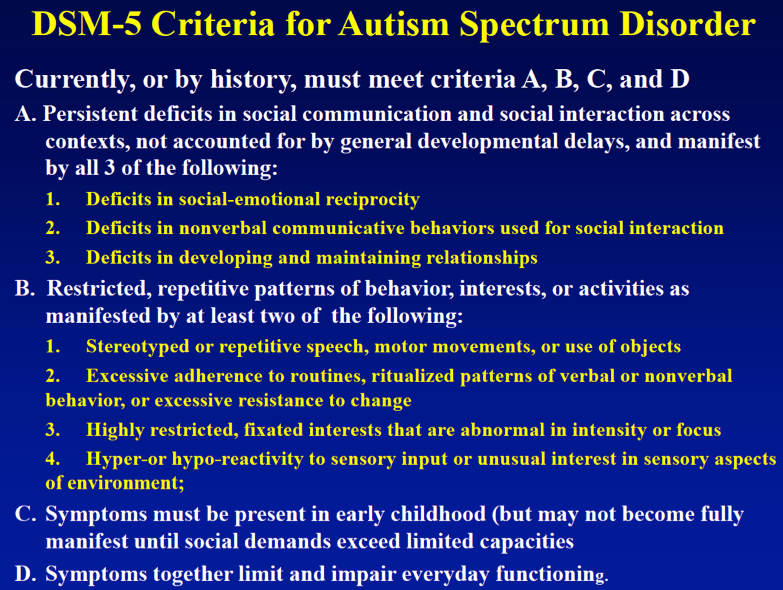
My diagnostic assessment was based upon the DSM-5 criteria. (The Diagnostic and Statistical Manual of Mental Disorders.) My thoughts on whether autism is a mental disorder (it isn’t) or whether an assessment based upon deficits is the best way of assessing whether someone is autistic (it isn’t) are irrelevant in some ways. This is the standard way of assessing Autistic Spectrum Disorder and getting this changed is a battle for another day. I will use this blog to look at the assessment criteria and describe what is going on for me when it comes to each of these manifestations of autism the clinicians look for when making a diagnosis.

The particular ways I demonstrate my so-called deficits aren’t that important. What is important is that people understand the diverse range of ways autistic people show or hide their autism. I will explain what is going on underneath the surface of some of my presenting behaviours. Each autistic person is different so I speak only for myself.

Criteria A

I have learned how to understand people and situations and have tried to study and find a script for every possible scenario that may happen on earth. This is clearly impossible and also extremely exhausting. I have learned to script conversations in my head and I am constantly second guessing what may happen. I understand body language – I can use my hands to add emphasis to a point I am making, I understand which words are appropriate to use in which contexts, and I have lots of stable and respectful relationships – but only within very strict frameworks like relationships with colleagues or family, where the boundaries are clear and expectations are laid out up front. Put me outside of my comfort zone where I have no script or framework with rules to refer to, and I struggle big time.

Of course, trying to take my scripts from one context to another doesn’t always go smoothly – no wonder I may use stereotyped speech or avoid social situations. As a child I would appear incongruously grown up for my age and talk like an adult. This was like handing my typical peers a double edged weapon to hit me with. Not only was I weird, but adults thought I was very grown up for my age too and my peers assumed I was showing off. Both things were worthy of teasing, bullying or disdain. Responses that further hindered my ability to interact with others and ate away at my self-esteem. I’ve got quite clever at using my scripts, I know how to add variety and ask open questions so that people talk about themselves. I can see patterns and go for a close match in conversation, rather than repeating the same conversation I’ve already had with someone. This has helped me build relationships and the more comfortable I am with people, the less self-conscious I feel. I don’t need to put as much energy into getting it right, and the conversation begins to flow naturally sometimes. Learning things in this way means I can give and take in relationships – it may feel clunky or robotic at times but is my best effort.

I’m certainly a caring person, so why the problems with emotional reciprocity? My interoception – or knowing how I feel inside, is frequently muted. The processing speed of my emotions is typically very slow. Have a read about my experience of empathy, it will explain this in more depth.

When I am having a conversation with someone, I am concentrating hard to understand what they are saying, to read their body language and work out the correct response. If this is someone I don’t know well or who uses lots of sarcasm or vague language, I have additional processing to do. I don’t get a gut feeling about things, I have to use logic to work things out. Very often I don’t really know what I like or dislike. This means that if someone tells me something about themselves e.g they experienced an accident, I know that I should say something sympathetic and not just ask lots of questions to seek clarification. But do I actually feel anything about their experience at that point? Well, no.

Later on, when I have had a chance to process what they told me, I can begin matching their experience to my own experiences to see what I think and feel about it. I might think then that their accident sounded awful and I may consider how I would feel in that situation. In my head I am looking for a pattern to match their experience to so I can understand it and say the correct thing in response. Too often, I get this wrong and what I believe is empathy, actually looks like I am making it about me and invalidating the person’s experience. Or it may look like I am not genuine, because my emotional response is delayed. I did ‘feel’ bad about the aforementioned accident, just so much later it would have looked weird if I had shown it.

This means it is often easier to avoid relationships because they are hard work. I don’t come across like typical people. I can offend people or appear to be self-centred or only interested in my own hobbies. I know this and try my best to not be like it, sometimes it’s easier to just avoid people rather than get it wrong. Not having a sense of liking or disliking things and people means I don’t necessarily get a lot of reward from relationships.

Small talk is tricky. It is full of statements that are not meant to be taken literally. “How are you?” is not meant to be answered honestly. To play along with the rules of small talk feels wasteful and dishonest to me. I appreciate it is part of what neurotypical people do to make their social interactions work – I view it a bit like when animals ‘play’ but are actually practicing asserting their dominance or place in the pack. I don’t really know why it is valuable in humans when they have the self awareness to just get on with being honest and not play games – it is not valuable to me. I would rather get straight to the point. It is like the foreplay of relationship building though, and by finding it difficult and avoiding it, it means I am less likely to get to the stage where relationships feel meaningful. The meaningful relationships I do have tend to be long lasting, loyal and strong. I have no difficulties with them at all.

Social interactions are also affected by my sensory processing. Eye contact in particular, involves masses of visual processing. My tactile aversion is triggered because if I am close enough for eye contact, I am probably close enough for touch. My sensory processing works very differently to my typically developing peers. If I am having a conversation, I will be consciously processing all the aspects of social contact I have just described, as well as the smell of the person; the sounds I need to focus on and the sounds I need to ignore; plus my proprioception and the need to stand or sit still, use my body appropriately to make the correct gestures, and adapt my tone of voice.

I may give the impression that I don’t socialise much because I don’t like people – not true. Or because I don’t understand how to interact – definitely not true, I probably understand it better than many people. I can’t see where the deficit actually lies. In fact, maybe it isn’t a deficit – I am genuinely having to process much, much more than neurotypical people have to process when interacting socially. No wonder it’s difficult!

Criteria B

I have touched on why I may be repetitive, and also on how my sensory processing is very different to that of my typically developing peers. When you begin to understand how my brain processes sensory information and how some of this is muted, and some of it is so intense it is painful, or so distorted it is not recognisable as being like that of my peers, you may get a feel for how challenging my world is to live in.

My need for predictability and routine becomes easier to understand. Rituals bring an added sense of control and familiarity, and repeating routines enables me to have some sense of being able to influence what is happening inside and outside of my body. My world is not predictable – my sensory processing fluctuates depending on how much I am having to process externally – e.g. in busy environments. Or internally – e.g. an illness I may not be feeling, or bodily functions I have to mentally search for in order to notice. Repetitive actions in themselves may feel very regulating or soothing to my senses, which is why I do them more when feeling under pressure.

Others may view my reactions to sensory input as hyper or hypo reactive. Believe me, my reaction is perfectly proportional to the reality I am experiencing! My unusual sensory interests are perfectly normal to me. I find it unusual that other people don’t hear music in colour or are so preoccupied they miss all the beautiful tiny details in nature that I see, hear and smell.

I am able to focus on subjects that interest me with an intensity that many others don’t possess. My lack of interest in what I perceive as an unnecessary focus on hierarchies and conformity in society, means I choose whatever it is I like to be interested in with an open mind, and frequently approach the subject in an innovative way. My interests provide me with consistency, predictability, and an escape from the stresses and strains of life. They enable me to be good at something in a world where I am frequently seen as deficient. They are a safe ‘go to’ when I need to place my mental energies somewhere.

Criteria C

Pretty self-explanatory – and a good test for anyone considering whether they are autistic or not. My autism was present before any of the other factors that shadowed me getting the correct diagnosis.

Criteria D

My functioning is impaired when I am in environments or communicating with people that are not accommodating of my autism. I thrive when I am in environments where my needs are met. My autism is exactly the same, I haven’t suddenly developed social ease or typical sensory processing. Of course, a medical diagnosis will be based on the medical model and not a social model of disability or illness. I always process the world in an autistic way. How big a problem this is depends on more than just me. It is up to you too.

Conclusion

Receiving a diagnosis has been positive for me. I understand my life experiences, challenges and strengths much more realistically. I feel able to be myself and I have more confidence. I hope that autistic people are listened to more readily, so that future diagnostic criteria for autism focuses on authentic autistic experience, and not just on how this looks to non-autistic people.

The examples I have given are my own personal ones. If any autistic people wish to add their own examples to the comments section, I would love to read them. Every person is different. The diagnostic criteria is based upon the manifestations of a person’s autism when it is observed in a non-sympathetic environment, or by professionals working within a system which views their own particular experience of the world as normal. I find the focus on deficits hurtful. I have spent a lifetime feeling deficient – and now its official! I don’t view myself as defective, and neither do other people who know me. Whilst the medical focus is on what autistic people can’t do, progress towards acceptance and understanding of autism will be hindered. And certainly there is no way of truly valuing us. I do not believe it is as simple as turning the deficits approach to diagnosis into a strengths based approach. I do struggle with things. We do live in a world where the majority of people are not autistic so that will inevitably mean I am different. Every autistic person will have different strengths, in the same way as they have different challenges. We are all unique. In the future, I would like to see clinicians developing an understanding of “why” and not just “what”. This will ensure that people who slip under the diagnostic radar due to their ability to mask their autism or who don’t fit the stereotypes will be able to be taken seriously when contemplating a diagnostic assessment.

I was diagnosed by clinicians who understood “why”. Their approach towards me was compassionate and interested. I was not made to feel deficient. I am not convinced that all clinicians understand the “whys” behind an autistic person’s presenting behaviours. Please share this article with whoever you feel needs to read it.

Categories
5 minute read autism diagnosis identity

Aren’t we all a little bit on the spectrum?

I’ve heard this said quite a lot – particularly since my diagnosis. Firstly I’d like to say “Thank You” to the people who have said it. I mean that sincerely. This has been said to me when people have been empathising, or trying to relate to my situation – it has even been said to soften the perceived blow of having a ‘disabled’ child. I am heartened that people want to put themselves in my shoes and I hope they bear with me and read this blog; reflect on other ways they can show their solidarity, and continue in their commitment to understanding autism.

Receiving a diagnosis of autism is a complex process. The diagnostic criteria is based upon clinicians identifying certain traits, experiences and behaviours, and all sorts of biases may come into play. This may be why certain groups of people are under-diagnosed or misdiagnosed.

In my opinion, the assessment criteria for diagnosing autism is based on stereotypes and deficits and could benefit from being updated. People who don’t fit those stereotypes, or are skilled in adapting to their atypical experiences of the world can easily be overlooked. However, there are some skilled clinicians out there that understand “why” autistic people do what they do and they are able to delve deeper and unpick all the various complexities of the person’s experience and identify whether autism is in fact the correct diagnosis.

Whilst every autistic person is unique and completely different to the next autistic person, we all have one thing in common. We have always been autistic. Autism is lifelong. No one becomes autistic as an adult, and there will be evidence of autism right from the very start.

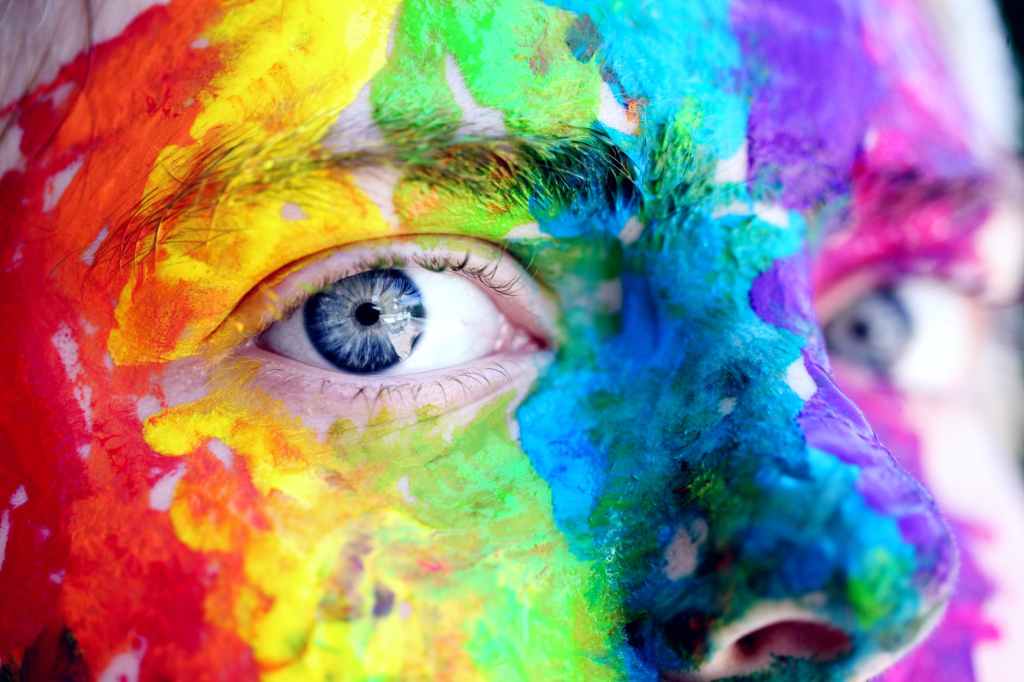
Apologies to anyone who is tactile averse. I wanted an image that demonstrated a ‘human being behind the spectrum’ – that paint looks a bit yucky though if you don’t like that sort of thing!

So are we all a little bit autistic?

No – we’re not. But we do share some experiences and behaviours. There is plenty of stuff about autism that is relatable to people who aren’t autistic. That’s why I enjoy using analogies to share my experiences.

If I described my atypical sensory processing, sensory overwhelm, and my need for adjustments in a scientific or medical way, it’s likely that you might see me as very different from you. That’s ok – I probably am. But if you can relate to a scenario such as this one then you may begin to ‘feel’ what it’s like for me as well as understanding why I’m different.

Picture this: You’re driving around in your car looking for a parking space and it’s raining, the radio is blaring out, the heater is on and you’re way too hot in the car. You’re thinking about that appointment you need to attend and what you’re going to say, and you’re not sure if you’re wearing the right clothes, and you can’t see an empty parking space. The windscreen wipers are swishing back and forth on maximum speed, and even though you are leaning forward and screwing your eyes up, you just can’t see where you can park. It’s all beginning to feel a bit much. So you turn the volume down on your car stereo and turn the wiper speed down – suddenly it becomes easier to find that parking space. You’ve done nothing to improve your vision, or the parking space detecting ability of your eyes, but the drop in volume means the overall processing your brain has to do of all that various sensory information is reduced and it becomes easier to focus. That’s similar to the level of overwhelm I often feel and why I need to have peaceful, calming environments to live in.

If you find that scenario relatable it doesn’t necessarily mean you’re autistic – but it demonstrates that all our senses work together and reducing input in one sense when we’re becoming overwhelmed may prove beneficial. It also demonstrates that when we are under pressure, sensory information may feel more acute or distressing. It gives a feel of what my ‘normal’ feels like and when people understand that, it is more likely they’ll be compassionate and accommodating rather than seeing me as ‘different’ or ‘other’. If they bump into me in town and see me starting to “look like a meerkat” as my husband and son (affectionately?!!) refer to it when I have to go into a big shop with all the lights, temperature change, music, smells and escalators, maybe they’ll not think “look at that lady acting weird, standing tall and alert like a meerkat on guard duty” but “I wonder if she is finding this overwhelming like I do sometimes and what can I do to help?”

So yes, we have things in common. But as I’ve elaborated on in an earlier blog – just because my husband has backache and is tired at the moment, it doesn’t mean he is pregnant. Or even a little bit pregnant. It just means he can relate – and that’s a good thing.

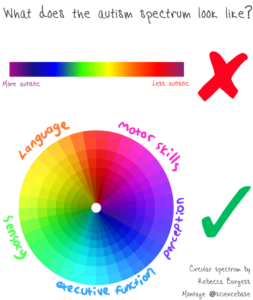
I find this diagram helpful for explaining the autism or autistic spectrum. The spectrum is not linear like the top image, it is more like the coloured wheel image below. I perceive non-autistic people as being a bit obsessed with hierarchies and linear things. I’m sure that individually people aren’t, but our society seems to enjoy ranking stuff – whether that’s a school’s league table or a football league or on a talent show – it happens all over the place. I’m a great lover of categorising things myself, but my default setting is not usually based upon the typically perceived norms of what makes one thing better than something else. It all feels a bit judgmental and you miss so much beauty in the world when you rank stuff and only focus on the “best”.

The trouble with having a spectrum with ‘mild’ at one end and ‘severe’ at the other is it’s total rubbish. Simple. You can no more be mildly autistic than you can be mildly gay. You can’t be severely human. Or a little bit on the French spectrum. It just doesn’t work like that. The characteristics and experiences autistic people share come under various categories and each person is affected differently by them. A person who has no verbal language skills with highly developed motor function will experience the world and be treated very differently to a person who is highly articulate with poor coordination. Each has their own challenges and strengths. Both are autistic and it feels difficult to say which of them is more severely affected by their autism. One can climb a mountain – one can make a phone call. How do you rank that? You begin to realise that the severity is nothing to with the person at all – but is to do with the situation or environment they are in. The social model of disability becomes far more relevant than the medical model we are more used to. The person hasn’t changed but suddenly when other people’s attitudes or their environment becomes more accommodating, they become less disabled.

Personally, I’m not too bothered when people try and relate to me by saying they are a bit autistic too. I have other battles to fight and if I tell them not to say it, I’ll reinforce that I’m pedantic. I want to build bridges between people, but I’d rather they didn’t say it though. I find it a bit annoying because it is inaccurate – and believe me, when your ‘normal’ world feels as chaotic as mine does, you need at least a few things to be ‘right’, ‘clear’, ‘accurate’ and ‘consistent’.

Many autistic people, myself included, have had a lifetime of knowing we are different to our typically developing peers. Some of us have believed – and been told – that we are ill, damaged, or wrong for being how we are. For some autistic people their diagnosis has validated their identity. For me, it has given me the freedom to be myself and the confidence to reject the incorrect labels others have given me or I’ve believed about myself. Some autistic people are loudly proud of being autistic. Hearing others saying they are a bit autistic too may feel invalidating or belittling of the very real achievements autistic people make every day in just getting by in a neurotypically biased world.

Many of my blogs end with a reflection on what we have in common. This is important to me because most of all, I am human. I have every right to exist – regardless of my neurology. My diagnosis has not just validated my identity as an autistic person but as a woman and a human being too. There is something very wrong when people wonder whether they are in fact a true human being – just because they are autistic.

I want to relate to other people and understand how their world works for each of them – I have spent my lifetime doing this and sometimes I try to copy, or pretend to understand so that I fit in better (this can be called ‘masking’ in autism, and I’ve blogged about it). I’d like people to have the same enthusiasm and commitment towards understanding the autistic world as I have towards understanding the neurotypical world. We need to recognise our shared humanity. Seeing people as “other” – whether that is in generalisations like ‘autistic people are like this’ or ‘all neurotypicals are like that’ is a dangerous road to go down. The rise of right wing politics across our planet scares me and we should take heed of what we know about how things like prejudice, stereotypes and discrimination work. Dividing people into “us” and “them” rarely leads to inclusion, equality and peace. In our own lives we can explore how to work together and see the shared experiences and use them to relate to each other better, whilst accepting we are all different and we all need different things. And that’s why human beings are so awesome!

Taken at Folly Farm in 2009 – I don’t have photos of me when I enter a big shop, but you can use your imagination and work out for yourself how I may look!