Categories
Autism autism diagnosis Uncategorized

So, you’ve just been diagnosed autistic!

“Please find attached your assessment report. As we have discussed, the report is written in a diagnostic format, focusing on aspects of you as opposed to the whole of you and your life story thus far”, stated the follow up email, from the follow up appointment, from the clinician who was part of the multidisciplinary team that assessed me for autism….

It was many years ago that I attended my assessment follow up, but I still recall the nauseating anxiety as the ‘big reveal’ day approached. I knew I was autistic, my child was autistic and I’m so like them, I HAD to be autistic surely? But what if they got it wrong? What if my gender, my past psychiatric history, those traumatising life events I’d experienced, got in the way and overshadowed my innate neurology?

My follow up appointment confirmed a diagnosis of autism (level 2). Additional sensory processing difficulties were also noted, along with my past history of anxiety, depression and trauma. The report gave the opinion that some of my previous psychiatric labels were likely to be misdiagnoses and argued that some of my mental health symptoms might be better understood in the context of autism and sensory processing differences.

So how did it feel to finally get this diagnosis of autism? In fact it was the 22nd diagnosis I’d received that is listed in the Diagnostic and Statistical Manual of Mental Disorders (DSM-5). Well, I felt ‘kind of something’ that I couldn’t quite describe – but this is normal for me, my autistic interoceptive experiences are often difficult to locate, label and explain. (Interoception is our sense system that picks up and processes body signals including pain, emotions, tiredness, hunger etc etc. Like our other sense systems, autistic people often experience sensory input differently – input may be heightened or muted, distorted, fragmented, delayed, synaesthetic, or otherwise different to that of people who are not autistic.)

Other newly diagnosed people express a whole range of human emotions when first diagnosed, including feeling nothing at all; feeling something intense; feeling validated, vindicated, relieved, terrified, angry, scared, joyful; or a few or all of these emotions; or something else entirely. Each person’s experience will be as unique as they are. There is no “right way” to feel or process the information that you are autistic.

I just received an autism diagnosis, so why do I feel bad?

Whilst a diagnosis of autism may be validating and a relief, it can feel painful to listen to or read a list of what you find difficult. Afterall, the diagnostic criteria is largely a list of deficits – medics don’t diagnose conditions based on an individual’s strengths!

It may hurt deeply to hear loved ones describe you in ways that feel derogatory or that misunderstand your motives. An assessment report or feedback from a clinical team may feel harsh and intense and I recall feeling ashamed of how much I struggle and how often (I perceive) I have ‘failed’. My assessment report sets out my challenges in black and white – unequivocal, harsh, embarrassing, dispiriting. My report states: “Emma manages daily life exceptionally well despite her impairments, she works hard to compensate for her difficulties which prevent them being even more significant than they are.” It felt good to read that my efforts were recognised – virtually all autistic people I have met and worked with, put in huge amounts of effort to get by and survive in a world that so often feels alien and hostile towards our neurotype. I amaze myself that I can keep going sometimes!

It was important to recognise that my assessment report was a synopsis of how I met the diagnostic criteria for autism. My achievements weren’t relevant. My efforts weren’t relevant. My exhaustion from doing my best wasn’t relevant. I have written more about the diagnostic criteria in other blogs . I like to think about my autism assessment like I do the car driving test – an artificial situation that you hope to do only once; that is largely dependent on your performance on the day, that scrutinises only specific areas, and is largely irrelevant to how you actually drive the rest of the time.

On receiving my typed report, I immediately noted a few (minor) inaccuracies that screamed from the pages. I recognise now that I was a simply one human, being assessed by other humans, and the assessor’s interpretation of situations I’d described was as affected by their biases as I am by my biases. It felt difficult though, when reading certain aspects of the report which led to those all-familiar feelings of being misunderstood. Of course, my eagle eyes were working at their sharpest when reading my report, on account of the expectation and anxiety that sharpens your senses and increases your vigilance when under threat – in fact, like all animals in a survival situation, I was tuned in to perceived threats and unable to pick up on cues of safety – and don’t think any typos escaped my keen observation! I’d recommend to anyone receiving the outcome of their assessment, to structure your time in the subsequent days so that you can do whatever self-care works for you and that will help with processing all the information. I have written about autistic self-care in other blogs.

Several years later, I can read my assessment report and feel very little. It doesn’t trigger me, and I have had time to process its contents in my own way. Processing, as the name suggests, is a process! I have thought and felt a variety of things about my diagnosis over the years, and no doubt will continue to do so.

Why did my new diagnosis of autism feel so good?

Quite simply, because I felt seen for who I am. For me, a person with multiple psychiatric diagnoses, some accurate, some questionable, my autism diagnosis explained how I experience the world and offered me a lens through which to revisit every life experience I’d had. My diagnosis made sense. It felt right – and as someone who likes things to be accurate, this was hugely important. My previous diagnoses had never felt 100% right. Sure, some of them resonated – anxiety and depression, for instance – they explained ‘what’ was going on, but not ‘why’ I kept finding myself in the midst of them. Other past psychiatric diagnoses seemed completely off target and almost the opposite of my lived experience. My autism diagnosis meant I felt validated. I almost felt like shouting to the world, “see, this is why I find everything so bloody difficult!”

Now that the outcome is sinking in:

It is normal to think and feel differently about your diagnosis as time moves on. Some people may never feel anything significant about their diagnosis. Other people may wish for the diagnosis to be taken away. Expectations about future support and understanding following diagnosis may be realised – or sadly as is so often the case, there is little support out there unless you are in crisis.

Here are some questions and scenarios that newly diagnosed people may ask or share, and some responses (responses are based on my personal and professional experience and are not recommendations).

Should I tell my family/my school/my workplace?

It’s up to you! Some people feel a need to tell the world they are autistic but there is no obligation to. You may choose to tell no-one. You may decide to share your diagnosis on a case by case basis. You might decide to blog about it and tell the world, like I did!

I’ve been told by friends/family/colleagues that I don’t seem autistic…

This is unsurprising in some ways because often people only learn about autism through the media and stereotypes. People may be comparing you to the only other autistic person they know e.g. a friend’s child. They may be unaware of how much time you spend masking in order to stay safe. There is no right way to respond to this situation and it might help to join online communities or find local peer support groups to discuss this with. I find that often people say this as a compliment, they are trying to be kind – but of course, it doesn’t feel like a compliment and can be invalidating. Whether you challenge people on this or not is up to you. I rarely do, but I am in quite a privileged position where I am usually taken seriously.

Aren’t we all on the spectrum?

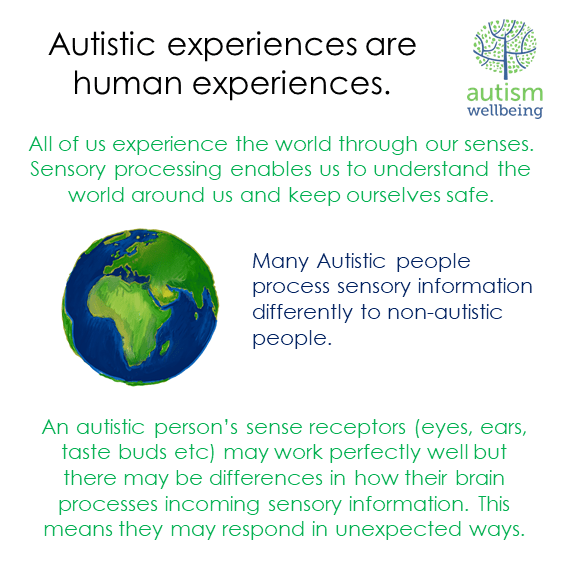
No. You may like to read this earlier blog or recommend it to people. Autistic experiences are human experiences. Most people understand what it is like to be so overwhelmed by your surroundings you can’t think straight; or to have your anxiety reduced by carefully planning your day; or understand the joy in hearing a tune so beautiful you can’t help but move. When we shift our thinking from “aren’t we all a bit autistic?” to “no, but we are all human” it can prompt us to recognise the inequalities autistic people face and question why some people experience distress and difficulty so much of the time compared to their non-autistic peers.

Here are three examples of common human experiences that autistic people may experience more frequently and more intensely due to the world not offering enough opportunities for inclusion:

1. It’s too noisy to think straight.

Autistic people may need to wear noise cancelling headphones or ear defenders to cope with everyday background noise, because our brains may not filter sound. It can feel overwhelming and panicky and we may be unable to focus on, or even work out what is important. Non-autistic people may recognise these types of feelings when trying to park their car when it’s raining heavily, the kids are chatting in the back of the car and the radio is on loud. Typically, they may ask the kids to be quiet or turn down the radio so they can find a parking space. (Note that a reduction in auditory input, frees up visual processing capacity. Our sense systems work together and noise cancelling headphones/ear defenders may be useful for reducing sensory input in many situations, not just ones perceived as noisy) It may help understand me better if you consider that my “normal” when it comes to noise, is like your “parking in the rain with the kids screaming and the radio blaring”.

2. You look like you’re over-reacting.

All humans find that our sense sharpen when we are anxious. Autistic people’s senses may often be sharpened on account of our different neurology. A survival response of fight/flight/freeze is not a choice, but proportionate to what our brains perceive. It certainly isn’t an over-reaction. If we are home alone at night feeling anxious and suddenly hear an unexpected noise in the house, it is likely to cause us to jump and may seem louder than the same noise during the daytime when we are busying about and there is an abundance of background noise.

3. A change of plan feels the last straw.

Most of us can relate to feeling deeply disappointed at a change of plan. Again, we need to consider proportionate responses. If I am distressed because you are five minutes late, it is not an overreaction and may be because to me, five minutes feels like 20 minutes does to you (I like to think the ‘sense of time’ is a human sense system too, maybe we could name it chronoception?). Maybe it’s because my imagination knows no bounds and I can think up infinite reasons why you may be late, but have no gut feeling about which of those reasons may be accurate. Once you are a few seconds late, I have no way of knowing when you may come and how this might impact our plans and the rest of my day – and planning my day is important because it provides some predictability to an otherwise chaotic experience. You’d probably be distressed if your holiday of a lifetime was cancelled. I may value my hobbies and interests as highly as you value your holiday, and feel just as distressed if my plans were changed.

Will I get more support at work/school now?

Perhaps. Not every school or workplace is equal in terms of reasonable adjustments and support that may be offered. Legislation is in place to ensure disabled people are not discriminated against but we know the reality is that often employers and educators feel helpless in terms of their understanding of autism and how to best support people. There are organisations that specifically support people in education and employment, they may be able to offer bespoke or more general support.

Why have I suddenly become more autistic?

It seems quite common for newly diagnosed people to embrace their diagnosis and reduce some of the conscious masking they have done. Those self-soothing habits I used to suppress, like rocking from side to side when waiting in a queue, felt permitted once I was formally told I was autistic. None of those “more autistic” things were fake or put on, I felt validated and “allowed” to be more authentic. I accessed a newfound confidence and was able to be more myself. Other people may have perceived this as me playing on my diagnosis, or they may have attributed some other motive to what they perceived as my out of character or exaggerated behaviour. I do recall appearing “more autistic” at first after my diagnosis, but it has settled now. This book was useful to me and I’ve recommended it to others.

It’s not fair. I’ve been bullied, misunderstood and treated badly, simply for being myself.

Correct – it’s not fair, and this may feel doubly harsh because autistic people so frequently call out injustices. Fairness seems important to many autistic people.  I have been working on cultivating compassion and self-compassion. It’s not easy when your life has been full of mistreatment and a continuous stream of micro-invalidations. (I use the word micro-invalidation to mean those comments that usually start with “no-one else is…” and end with something related to our way of experiencing the world e.g. “complaining about the food/lights/noise/moving about/not paying attention/forgetting their book”).

I’d like to say that I don’t dwell on the negatives, but with a brain that can hyperfocus, seek solutions to problems, and ruminate on injustices with the strength of superglue, it is not easy to unstick these type of thoughts. Many of us could have felt intense shame for how we are, we may have internalised stereotypes and negative ideas about autism and find self-compassion is an alien concept. As I’ve processed my diagnosis, re-evaluated my life through the lens of autism, and got to know myself more deeply, I feel more at peace. Again, it is a process.

I’ve moved through experiencing validation and relief, to finding disappointment that the world is still as tough as ever post-diagnosis. I’ve felt proud to be autistic, embarrassed to be autistic. I’ve chosen to mask my autism when it’s less costly than being open about it. I’ve felt angry at the bullies, angry at the medics who repeatedly got it wrong, angry at society for having an accepted culture of mocking differences. Writing helps me process things, so I’ve written lots. I am bringing up my child to be unashamedly themselves.

What can I do to make life easier?

It can be a harsh realisation when you recognise that the world continues to be a challenging place to exist. Here is a non-definitive list of ten things that may make life easier:

  1. Play to your strengths and use your need for routine, your ability to hyperfocus, your incredible eye for detail, or whatever your strengths may be to have a fun and fulfilling life.
  2. Don’t feel you have to tell anyone you are autistic unless you choose to.
  3. Don’t feel you have to hide you are autistic either.
  4. Explore your sensory profile. Those sensations you seek out or avoid. Plan regulating sensory experiences into your day. These are experiences that help you feel balanced and at your best. I find walking, stretching, using headphones, stroking soft material, crunching crisps, all help me be regulated.
  5. Consider creating a one-page document that lists how others can help you best. You may like to share it with work/school, hospital staff, group leaders etc. If you are stuck for ideas, leave a comment and I’ll share some examples you might like to adapt.
  6. Be proactive with your self-care and self-regulation.
  7. Read, watch and learn about autism from other autistic people.
  8. Be kind to yourself. This can be tough if you’ve felt there was something wrong with you prior to realising you’re autistic.
  9. Find out about reasonable adjustments at school and work and consider what may help you. Internet searches will bring up many organisations that have free resources. Here’s a link to an employment event where I delivered a workshop for the National Autism Team in Wales.
  10. You don’t require a formal diagnostic assessment and diagnosis to be autistic. Afterall, you were autistic before you got your diagnosis. Assessment is not available to everyone, for a variety of reasons, or you may simply choose not to pursue a diagnosis by this route.
Categories
Autism

When sensory experiences don’t make sense!

Can my sensory differences really feel like this? This blog explores some of the interesting, terrifying, joyful, stim-tastic, and plain strange, ways that humans – especially autistic humans – can experience the world through our sense systems.

The medical language about autism uses words like disorder, abnormal and atypical, and suggest that there is one, standard sensory processing norm from which Autistic people deviate. This is not the case. Each of us, Autistic and non-autistic alike, has our own individual way of processing sensory information.

How does our sensory processing system work?

Each and every one of us experience the world through our senses. Sensory processing is the process by which the nervous system receives, organizes and interprets sensory information. Sensory processing helps us figure out how to respond to environmental demands based on the sensory information available to us. As humans, we are constantly picking up sensory information from our environment via our sense receptors. As part of this subconscious process, our brains filter out sensory information that is safe to ignore so that it can focus on information important to tune in to. We also process sensory signals arising from within our body that help us to know how we are feeling, where our body is in space and the effect of gravity on our body.

Some examples of this include:

  • If I see a light that is very bright, I look away or shield my eyes.
  • When I open my refrigerator and smell the opened bottle of milk, I can tell if it is fresh enough to drink, or if the smell makes me gag, I pout it away.
  • If I climb up onto a step ladder and feel unstable, I climb back down.
  • When I notice that I need the toilet, I use the bathroom.
  • When my favourite song comes on the radio, I get a feeling of warmth in my body and I can’t help but move my body to the beat.

Being able to use sensory information in this way helps keep us safe; helps meet our body’s needs – eating, drinking, using the toilet etc; and tells us how we feel about things.

Survival Responses

When we feel threatened – when our brain perceives a threat in the environment – we instinctively take action in response to that threat. Our three main survival responses are fight, flight or freeze. Sometimes, when we are feeling regulated and in a safe place, we may be able to override these survival responses and cognitively weigh up the extent to which we are actually threatened.

Sensory Trauma

On account of our sensory differences, Autistic people may live our daily lives in a state of heightened stress and anxiety, many of us experiencing Sensory Trauma. Sensory Trauma may arise from painful and distressing sensory experiences. For many of us, these painful or distressing sensory experiences are associated with activities that are typically part of normal
everyday life. We may then face the additional trauma of not being believed, being mislabelled as over-reacting or attention seeking and even in some cases (mis)diagnosed as mentally ill.

The invalidation I experienced growing up consisted of messages along the lines of “Nobody else is complaining about the noise hurting their ears, you always have to make a fuss” or statements starting with “The trouble with you is….”. This, along with the painful sensory experiences that accompanied my daily life, eroded what limited sense of agency and self-esteem I had, and made me question my reality. My identity was already shaky due to the muted way I experienced awareness of where my body was in space and the muted sense of how I felt about people, situations and myself. I knew that I experienced the world differently to most people – and the messages I received about that, were that I was wrong! I became engulfed in shame.

If you’d like to read some examples of Autistic people’s sensory experiences, Autism Wellbeing’s free downloadable booklet, Autism: A Guide for Parents offers further insights, and is a piece of work myself and my colleagues created with the testimony of Autistic adults. You will find the booklet on our free downloads page.

https://www.autismwellbeing.org.uk/resources

As Sensory Trauma and the potential for Sensory Trauma are ever-present over the course of our days, as Autistic people, we may spend our waking hours constantly on edge, hypervigilant and at risk of tipping over at any time into one of the three survival responses. The longer we live in a state of heightened anxiety, the more our nervous system becomes used to functioning in that mode or on that “setting”. We may become habituated to being on the look-out for the next potentially distressing sensory experience.

If you’d like a more in-depth read about autism language, sensory processing and Sensory Trauma, take a look at our work.

http://www.autismwellbeing.org.uk/sensory-trauma
Buy the book (free on Kindle Unlimited)
Sensory Profiles

Each of us has sensations that we like or are able to tolerate, as well as some we do not like and find difficult to tolerate. Many Autistic people process sensory information differently to our non-autistic peers. For Autistic people, our sense receptors (eyes, ears, taste buds and so on)
may work perfectly well but there may be differences in the way our brain processes the incoming sensory information.

The two most well known sensory processing differences are due to experiencing sensory input in a heightened or muted way. My brain usually processes auditory information in a heightened way. This means I only need a relatively small amount of noise to register with my brain, and loud noises are processed as painfully loud. Whereas I need lots of proprioceptive input before I notice what my arms and legs are up to, on account of my muted proprioception. This means I tend to use too much force and appear heavy handed or clumsy. One of my earlier blogs explores sensory processing in more depth.

Sensory processing does not happen in isolation, it is not just about our ability to process that particular piece or kind of sensory information. Sensory processing is dynamic and highly context specific – it is about how we experience a specific sensation, at that particular time (in light of what has come before and anticipation of what may come next), in that particular environment, in the company of those particular people, whilst in that particular emotional state.

Sensory Modulation

Sensory modulation is an ongoing process – it’s how our brain fine tunes incoming and internal sensory signals so as to make sure we are in a state of balance where our capabilities are open to us to use. Sensory information is constantly being registered in the brain and sensory modulation continuously makes adjustments to help us function, learn and connect with others optimally. Being in this optimal state means feeling calm and alert, being open to new experiences and available for intellectual challenge, social interaction and emotional connection.


For people who have developed in a so-called typical or expected way, sensory modulation goes on all the time, ticking along subconsciously in the background. For those of us who are Autistic, (or have experienced trauma), the process is not always so smooth and many of us have developed idiosyncratic ways of being in the world that support our sensory regulation. The things we do as Autistic people to help us become regulated, may not be things that other people would ever do. We often develop highly effective sensory strategies that help us become regulated – but these strategies may be pathologised by others. This blog about the pathologisation of self-care contains my thoughts on this.

Examples of sensory strategies that Autistic people may use to regulate themself might include rocking, head banging, flapping, jumping, spinning or hitting objects. Repetitive sequences of activities and sorting things into categories may also be part of our self-regulating strategies. Autistic people engage in such sensory activities in an attempt to help us feel
embodied and safe.

Our brain’s information filter

Human brains have evolved to continuously filter out sensory information in our environment to which we do not need to attend, for example
the sound of the fridge humming or the whirr of the computer.
Sometimes, Autistic people are unable to filter out certain sensations and we may experience all sensory information in our environment with equal intensity. Conversely, we might be an Autistic person whose sensory “filter” may be so effective that it filters out too much information
and we might appear disconnected from the world around us. For some Autistic people, these sensory processing differences may vary both within and across sense systems. In addition, sensory processing differences may depend on the setting as well as our emotional state. For instance, when my wellbeing is optimal I can cope with background noise when I am working, but when I am stressed or in an unfamiliar environment, any noise can feel too much. Like many experiences in life, this variability is common across all people, Autistic and non-autistic alike. We may all have “off” days, or be unwell, overworked or under pressure, and our sensory experiences will likely be affected by these states.

Distortion, Fragmentation and Delay – This is where sensory processing gets weird!

For some Autistic people, sensory signals may become distorted as they are processed in our brains. For example, when I become stressed or overloaded, my capacity to perceive dimensional depth can diminish with the result that my environment may appear flattened and two-dimensional. Once familiar places look the “wrong” size and faces seem to distort and rearrange themselves like a surrealist painting. Some Autistic people report losing the capacity to identify or distinguish between their interoceptive sensations. Again, this capacity is often a shared human experience – many people report feeling “hangry” – a feeling of anger or irritability when hungry.

Sometimes Autistic people may be able to see a part of their body but not feel it. Whole sense systems may shut down as processing of incoming sensory information becomes too much for the brain to manage.
Delays in processing sensation may occur because the sensory information takes time to register in and be processed by the brain. This can often be clearly seen in Autistic children who experience delay in processing pain signals, with the result that they may react to an injury and its associated pain minutes or even hours after the injury occurred. My experience of pain tends to be muted. I have tried to walk off a dislocated knee! My blog about “saying ouch in all the wrong places” describes my unusual interoceptive processing in more detail. I am more able to place my pain when I have support to understand where it emanates from – a year of GP visits about earache with no evidence of infection, followed by dental appointments and an oral X-ray, showed I had an untreated abscess in my jaw. Upon seeing the X-ray image, I felt the pain in my jaw in the right place, rather than as a general feeling of “I’m not ok, I think its to do with my head but I’m not sure”.

“My fingers aren’t there! I’m sat scrolling through my newsfeed on social media, trying to tap on a message to open it and my fingers have disappeared. I can read the screen of my phone but there are blank, blurry patches where my fingers should be. I move them – or do I? I can’t see them and I’m never quite sure, when I can’t see bits of my body, whether I can actually move them or not.
I slowly move my phone around and realise that I have tunnel vision with a ring of pixelated, almost kaleidoscopic vision around it. If I move my head, I can fix what I am looking at into the centre of my vision so that I can see
it. This isn’t right, but I feel OK. I quickly scan through my body: head – OK, no pain, no dizziness; limbs – OK, no pain, they can move; body – my heart isn’t doing anything unusual, no pain or fluttering or sickness from my tummy. I can think normally; I’m not worrying; I’m not
preoccupied; I’m just going about my business as usual and this has happened. This visual disturbance lasted for a few minutes and then disappeared as suddenly as it came. It happened a few times over the next few days….
My dad died the day before I experienced this visual disturbance for the first time” (from Good Autism Practice Journal, May 2020)

Perseveration – where sensory processing gets even weirder!

This short film from National Autistic Society shows the phenomenon of perseveration.

Before I understood that I was Autistic, I firmly believed that there was something seriously wrong with me. A school bell bringing the day to a close and piercing my ears and body with pain, would still be looping round my brain and body hours later – just as painfully. Conversations and images from last week would be on continuous autoplay in my mind and jolt me awake as I was about to drop off to sleep. Situations that involved lots of information and sensory input to be processed were the most likely culprits of these invasive and intrusive sensory experiences. It is as if my brain and body are an airport and all the sensory and cognitive input are aeroplanes that land on the runways and take their place neatly in the various hangars. Only, if there is too much input, these planes have to stack up and keep circling until the runways are cleared. A simple way for people to help reduce this is to give me enough time to process series of instructions, particularly when they are being given to me in environments that have the potential to overwhelm me.

My Secret Weapon

Perseveration can be painful, distressing and overwhelming. It can also be my secret weapon!

This is because it is not only the painful and distressing sensory input that gets stuck in my body. Positive sensations can too. I have a good life on the whole. Proactively keeping myself regulated enables me to be at my best for trying new things and coping with the unpredictability of life. Just as certain sensory input has the potential to be traumatising, there are other types of sensory input that bring me joy. There are further types of sensory input that are regulating and if I give myself little top ups of this input throughout the day, I can remain in an optimal state and have increased resilience. Each of us will have our unique preferences for regulating sensory input, and for me, the types of input that perseverate most effectively include listening to music with lots of bass (so I can feel it throughout my body and not just in my ears), glissandos (a musical term for when one note glides into another – Led Zeppelin’s Whole Lotta Love, Gershwin’s opening bars to Rhapsody in Blue, and loads of Pink Floyd tracks use glissandos), weight training and stretching, weighted blankets and bear hugs. Proprioceptive input seems to be particularly effective at perseverating in a positive way.

I hope this blog has provided some knowledge and reassurance to those who are scared, confused or overwhelmed by their sensory experiences. Why not read some of the blogs and information I’ve provided links to and explore how you can use sensory input to become and remain regulated…

And never stop seeking those sensations that stick around in a positive way, or that bring you joy!

Categories
5 minute read Autism identity interoception sensory trauma Uncategorized

Making sense of feeling unsafe

A blog about mental health, emotional distress, autism and hope.

I feel like I am unravelling. Thoughts are like words outside my head. My body seems to be somewhere else. Where “I” end and everything else begins seems fuzzy, fluid, and fucked up.

Am I in pain? I don’t know.

Am I upset? Not sure.

What do I want and need? No idea – and please stop asking all those difficult questions!

I’ve had a tough few weeks that culminated in a car crash a fortnight ago. The hospital scans show that thankfully, I have no broken bones. My bruises reveal I am injured. My sensory processing indicates something is very, very wrong and I must prioritise self-care.

The one question I can answer is “Do I feel safe?”

My answer is a resounding “NO!”

My lived experience of mental illness, emotional distress and sensory processing differences, is one of fear, uncertainty and feeling very, very unsafe. As an autistic person, my experience of the world tends to be chaotic and unpredictable at the best of times and when I factor in traumatising events, illness and injury, the chaos goes up a level!

Sensory Processing

All of us experience the world through our senses. In addition to the five senses that are involved in processing sensory information coming into our bodies from outside: touch, taste, hearing, sight, and smell, we have three more sense systems: our proprioceptive, vestibular and interoceptive sense systems.

Our proprioceptive sense system is used to process where our body is in space and where our limbs are in relation to each other. Try this… Close your eyes, put one arm out straight in front of you with your thumb up. Then, keeping your eyes closed, reach out with your other hand and arm and grab that upright thumb. How you perform is based on your personal experience of proprioception in that moment.

Our vestibular sense system is used to process the effect of gravity on our body. Some of us love a rollercoaster, some of us feel queasy on a calm sea.

Our interoceptive system is used to process emotions. These emotions are grouped into homeostatic emotions which include tiredness, hunger, pain, needing the toilet, and our other internal states; and affective emotions which include anger, excitement, fear, joy and all those other feelings we experience.

The way we experience sensory input depends on our unique sensory profile – those sensations we enjoy and seek out, and those we dislike or avoid. Autistic people tend to have sensory differences because although our sense receptors (eyes, ears, skin etc.) could be working fine, our brains frequently find there is too much or too little sensory information to register. This means we may experience sensory input in heightened or muted ways.

How we experience emotions will depend on how we experience interoceptive signals. For some of us, some of those interoceptive signals may be muted – perhaps we don’t notice we are hungry until we are so ravenous, we can’t stop eating. Or perhaps we might – like me – try and walk off a dislocated knee as it twinged a bit but surely couldn’t be anything serious! If we experience interoceptive signals in a heightened way, a small amount of pain may be unbearable or we may always feel like we need the toilet, even when we don’t physically need to go.

Like most autistic people, I tend to experience sensory input differently to non-autistic people. My personal sensory profile is typically one of muted proprioception and interoception, whereas my sense of hearing and smell are often heightened. But this varies, just as it does for all of us. If I have a lot going on, my muted proprioception gets even more muted and I’ll find myself bumping into doorways even more than I usually do. My hearing may get even more heightened and human speech pierces my ears with pain and vibrations that make me respond as if I am being tortured.

My personal sensory experiences are like most peoples (autistic or not) – variable – and dependent on how I feel, who I am with and what is going on around me. Sensory processing is dynamic. This may sometimes be misinterpreted as the autistic person over-reacting or deliberately being oppositional, especially when on one day they may tolerate a sensation e.g. the noise of the dishwasher being unloaded, but find it painful the next.

When my wellbeing is poor, when I am ill or stressed or already processing too much information, my sensory experiences become more extreme – even by my own standards. Unsurprisingly, the events of recent weeks have resulted in my brain having way too much to process, and my sensory processing experiences have let me know all about it!

How might this look?

Most people are probably unaware that our brains are constantly working away in the background, fine-tuning sensory information. We need a balance of sensory input to be at our best and to learn and take part in social interactions. This seems so obvious, it hardly needs saying, but for those of us who often find there is often too much or too little sensory information, life can be more difficult. Those of us who are autistic are likely to experience differences in how we process sensory information. In addition to experiencing heightened or muted sensations, our processing of sensory information may be distorted or delayed or fragmented. Some sensory information may perseverate or stick around repeating itself long after the event has passed.

Here are a few examples from my lived experience:

  • People’s faces look distorted when I’m walking around a crowded shopping centre. Like their facial features are melting.
  • I can still hear the school bell in my ears and feel the horrible sensation in my body at 6pm, even though it went off to signal the end of the school day at 3.30pm.
  • Synaesthesia – I see musical chords as colours, and numbers as coloured shapes. Always.
  • When I am very upset or have had a shock (e.g. the death of a family member), I don’t feel sad but my vision gets patchy and I can’t see my fingers when I am trying to use my phone. I might “feel” sad months later. This can be misinterpreted as me not letting things go – when in fact, I am only just feeling them.
  • If I am overwhelmed, I feel seasick when walking and cannot bear to slow down, speed up, or change direction as I feel I may vomit.
  • I hear “echoes” of previous conversations replaying out loud when I sit quietly.
  • I cannot tell where my body ends because my proprioception is so muted. I may unknowingly invade other people’s personal space or fail to recognise my own body in the mirror.
  • I hear my thoughts and they seem to become “out loud” rather than inside my head.
  • I feel edgy, suspicious and on high alert.
  • I want intense pressure, and even pain. My body craves intense and extreme physical input. This can be misunderstood as me being reckless.

When there is far too much or far too little sensory input to register with our brains, we become dysregulated.

How we up and down regulate ourselves will depend on our own personal sensory profile – and whatever else is going on for us at the time. As an autistic person, I often find that there are fewer opportunities to regulate myself in daily life, due to my natural sensory differences. If I enter a busy shopping centre, my brain finds there is way too much of everything and I could easily become overwhelmed. If I instinctively regulate myself by stretching, or bouncing up and down, or by humming a noise that drowns out some of the unpredictable background noises, I may be at risk of being asked to leave due to my inappropriate behaviour. Read more about this in my blog ‘ Autistic traits: when self-care gets pathologised ‘.

Sensory or Psychosis?

Some of the descriptions of my lived experience may sound like hallucinations or symptoms of psychosis, and for many years my undiagnosed autism was treated as mental illness.

Things get tricky when we try and unpick what is going on for autistic people who are distressed. It is known that autistic people are more likely to experience mental illness than our non-autistic peers. It hardly seems surprising when the world we experience is often more painful and extreme due to our sensory processing differences. It is also unsurprising when we consider how our lived experience is often invalidated with comments about us “overreacting” to things other people aren’t even aware of.

Learn about Sensory Trauma www.autismwellbeing.org.uk/sensory-trauma

If we have seen ourselves as mentally ill and our sensory experiences as symptoms of psychosis then we may perceive ourselves to be deteriorating or experiencing a relapse when we are experiencing sensory overload. Of course, autistic people can be mentally ill and experience relapses and those of us who have support in place to manage those times should always seek input from the people we trust to help us with our wellbeing. My story of mental illness was one of feeling like I lacked resilience and couldn’t cope, because when the going got tough, my senses got going! For me, an increase in sensory processing disturbances would usually result in an increase in antipsychotic medication. However, whilst medication dampened down some of my distressing sensory experiences, it also dampened my joy.

For anyone reading this who is beginning to question their own mental health and medication, I urge you to talk things through with someone else before considering changing your treatment. I did gradually change my treatment, but only once I had found a reliable way of managing my wellbeing effectively. I still use medication for my mental health, but I am also incredibly proactive in keeping myself regulated.

Managing urges to self-harm

Self-harm was a daily part of my life for many years. It is not something I have done for a long time and it is thankfully, something I rarely crave anymore. There are times where the urge is still there, but I no longer feel bad about having those urges. It is unsurprising that I have cravings when it was my “go to” for so long in the past. Just like any other craving or urge, I use it as cue to give my body what it needs.

If I feel thirsty, I use it as a cue to have a drink. I have the choice as to whether that drink is a cup of tea, a glass of water, or 5 pints of beer!

If my legs feel restless, I use it as a cue to go for a walk. I might have a gentle stroll, a 5 mile hike, or a jog round the block.

If I feel tired, I might have an early night – or I might not! The choice is mine.

Sensory processing is what we use to identify what is going on within and around us – and how we respond to it.

When I feel the urge to harm myself, I use it as a cue to increase my proprioceptive input. Proprioception is my “go to” sense when I am craving intense physical input. Proprioceptive input helps us feel safe – that’s why we might enjoy a hug, or squishing our body into a tight space, or wearing snug fitting clothes or doing up our shoes extra-tight so we get a good sense of where our body is. Clinicians often hypothesise over why people self-harm. They quote people as “managing intense emotions” or “a cry for help” or “punishing themselves”. These may well be factors and like many human experiences, there is rarely a single explanation, but no-one has ever described self-harm to me as being due to “needing a big dose of proprioceptive input to make me feel safer”. But for me, and many of the people I have supported in my professional career, some of our self-harm is a very human, very natural craving for proprioceptive input – which makes a lot of sense when you consider our sensory differences.

Proprioception comes from the Latin meaning ‘to know oneself’. That is exactly what this sense does. It gives us a sense of where our body is and where our limbs are in relation to each other.
The proprioceptive signals are sent from our muscle spindles, ligaments and joints up to the brain to be processed. For many of us who are autistic these signals can be ‘weaker’ or ‘blurry’ which can leave us feeling like we have an unclear sense of where our body is.

Humans are complex and our coping mechanisms are complex. Understanding how we respond to distressing situations, whether sensory or otherwise, requires us to be nuanced in our considerations, and a short blog like this one is not able to unpack this level of complexity. My aim was to share how my own responses to distressing life experiences are always impacted by my autism and sensory differences. Identifying which experiences are mental health symptoms and which are not, isn’t always relevant. Being able to regulate myself is what is important. Being regulated helps with wellbeing, whatever the cause of the distress.

Proactive regulation

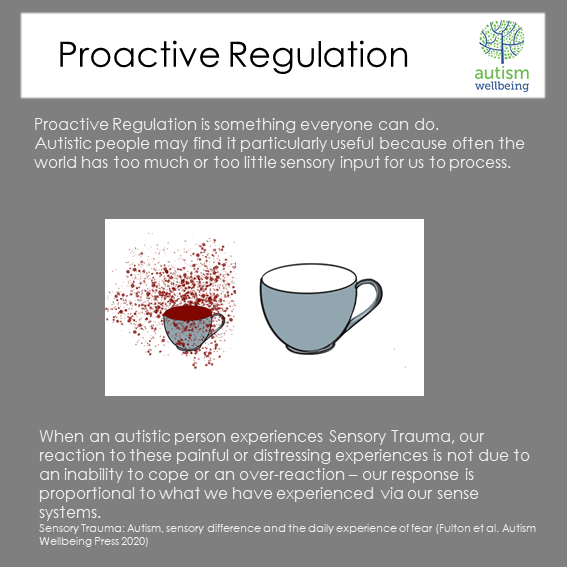
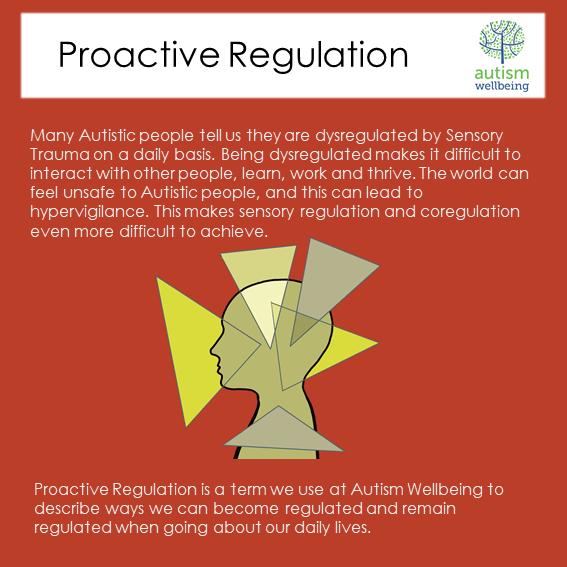
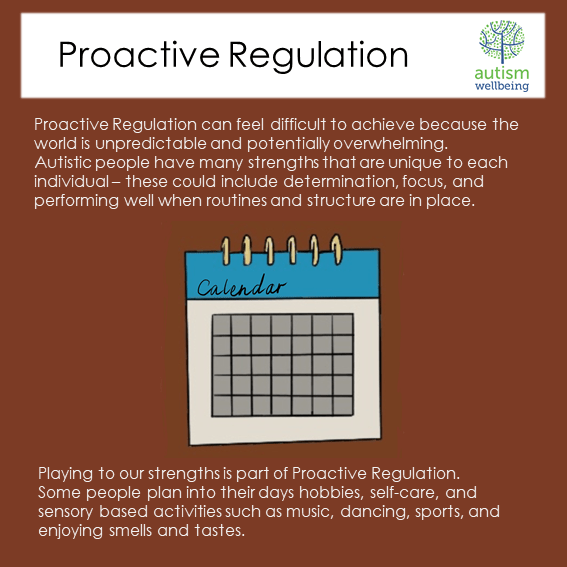
Proactive Regulation is a term Autism Wellbeing UK uses to describe how we can make sure we regulate our senses and emotions throughout the day so that we can function at our best.

For us, this might include wearing headphones in a busy shop, or carrying a scented inhaler tube to smell to help us feel grounded.

Proactive regulation also means showing ourselves self-compassion where possible, by avoiding or delaying activities that are likely to dysregulate us rather than pushing on regardless. Turning the habit of self-harm into a habit of self-compassion has been as time- and energy-consuming as making or breaking any other habit. BUT…

It has got easier the more I have done it. At first it was about “doing” rather than “feeling”. My brain and body craved intensity and pain and I had to push that to one side while I was compassionate towards myself. At first it felt unnatural, clunky, ridiculous and fake!

Me doing my self-care when it was new to me!!!

Mostly, when I feel distressed these days, I automatically see it as a cue to do some self-care, show myself compassion, and regulate myself. I even feel able to reach out to others that I trust. Here are some infographics about proactive regulation. It is important to be regulated before you need to be, in fact you can stockpile regulating sensory input for later. Just as I described feeling the distressing effects of the school bell hours later, or hearing “echoes” of previous conversations in my quiet moments, I can feel the positive effects of regulating input hours later too. Proactive regulation has been a game changer for me.

Thank you for reading this blog. I was unsure about whether to add trigger warnings as what triggers each of us may be different. Even trigger warnings can be triggering! This blog is one of positive change and hope. If you need help with difficult and distressing feelings raised by this blog, please reach out to someone or contact the Samaritans or other organisations.

Categories
5 minute read Autism autism diagnosis

Autistic traits: When self-care gets pathologised

In order to receive a clinical diagnosis of autism, a person must meet certain criteria. Aside from the damaging and negative language that describes our way of experiencing and responding to the world as deficits, these criteria don’t really tell us anything about “being” autistic. They are interpretations through the medical and neurotypical gaze of what autism looks like if you aren’t actually autistic yourself. (Not dissimilar to claiming the scientific “proof” that a coconut is in fact a mammal because it has brown hair and produces milk – it certainly meets some of the criteria for being a mammal!)

A clinician with absolutely no understanding of what it is like to be autistic could take these criteria and use them as a checklist against which to compare a person. We know Autistic people protect themselves by masking or camouflaging their autism (sometimes automatically and without choosing to), and we know that certain groups of people are less likely to receive a diagnosis of autism and are more likely to receive differential diagnoses that overshadow their autism. The road to correct diagnosis is a rocky one. But this blog is not about that. These are areas that desperately need further research and exploration, but I will stick to my theme of autistic traits indicating self-care rather than being the deficits so often described.

What do we mean by self-care?

A dictionary definition of self-care describes: “The practice of taking an active role in protecting one’s own well-being and happiness, in particular during periods of stress.”

In popular culture, self-care has become synonymous with bubble baths and herbal tea, but self-care can actually be an act of political warfare, or simply the stuff we need to do everyday to be at our best. Proactively regulating ourselves through increasing and decreasing sensory input can be part of our self-care.

For instance, we might wear noise-cancelling headphones in a shop, so we can reduce the sensory input from the speakers blaring out loud music and the background noise of extractor fans and chattering customers. This may make us better able to socially interact with the shop staff and complete our transaction less painfully.

What if we don’t have those noise-cancelling headphones to hand?

We might make a repetitive noise, repeat words out loud, or hum a note that blocks out all that background hubbub. This could have a number of effects, including:

a) our noise blocks out some of the background noise

b) it creates some predictability and therefore, feelings of safety in an otherwise stressful situation

c) it may provide regulating sensory input through the pleasant sensation of making the noise with our mouth

How might this look to an observer?

Observers might think various things about us making a repetitive noise – anything from a lack of understanding, “why if they don’t like noise are they making such a racket?!” to the more pathologising observation that the person is showing stereotyped and repetitive use of speech or hyper- or hypo-reactivity to sensory input. Both opinions offer up explanations from an “outsiders” point of view rather than understanding autism from the inside.

How many other traits of autism are in fact Autistic people practising self-care?

I have worked in the field of health and social care for 30 years and have met Autistic people who have severe learning disabilities and physical disabilities, Autistic people who are articulate in using speech, signing, actions and gestures, and other forms of communication. I have had Autistic colleagues and friends. All of whom meet those criteria for diagnosis set out in the DSM-5. Each Autistic person is unique, just as everyone else is unique – that is why we refer to the human race as neurodiverse – all minds are different.

My professional and personal experience tells me that Autistic people instinctively and intuitively do what we need “in protecting one’s own well-being and happiness, in particular during periods of stress.” And my goodness, it is stressful living as an Autistic person in the world. No wonder we have to find ways to protect our wellbeing.

What else could be going on?

I would love to hear your comments, reflections and thoughts. Here are a few of my own examples of how those “deficits” described in the diagnostic criteria may in fact be coping strategies and self-care activities used to help me exist in a world that is so frequently not set up for people like me:

  • My social challenges often come from being overwhelmed due to having too much sensory information to process. When I am better regulated and therefore not in a survival state of fight, flight or freeze I am more able to access what is referred to in polyvagal theory as my social engagement system. The things I need to do to be regulated may look different to those things non-autistic people do. This isn’t due to a deficit, but simply down to my experience of the world being different to theirs – seeing as my experiences are different, no wonder my responses look different too!
  • I use my body to self-regulate – how wonderful is that! When I have no equipment to hand I can still move my arms, bounce up and down, or make a favourite noise repeatedly. (referred to in DSM-5 as stereotyped use of movement)
  • My so-called special interests are not special in terms of topic – it is not my fault that other people seem to select from a somewhat restricted choice of interests. The abnormal intensity and focus following these interests (as described in the DSM-5) brings me a sense of calm, a sense of achievement in a world that frequently puts me down, and an opportunity to recharge. All great examples of self-care. In fact, some research by Porges described in one of his books about polyvagal theory and feeling safe, quotes: “a reduction in heart rate variability was a robust indicator of sustained attention and mental effort”
  • My sensory responses are only hypo- or hyper-responsive, or abnormal, if you are comparing them to your own experiences and assuming yours are “normal”. In our neurodiverse human race where each of us has a wonderfully unique mind, how can we define normality anyway? When you understand that my sensory experiences are different to the majority of peoples, you may begin to understand that my responses are different too. Different, yes; AND proportional to my experience. A proportional response cannot surely also be a deficit?
  • My work as one of the directors of Autism Wellbeing CIC included co-authoring Sensory Trauma: Autism, sensory difference and the daily experience of fear where we generate a novel “Sensory Trauma” framework in which to (re)consider the lived experience of Autistic people. We explore the concept of affordances and how the same environment affords each of us a different sensory experience

Conclusion:

It is difficult to define autism. In my opinion, the DSM-5 criteria offers a highly restricted view of autism that is fixated on how autism is perceived by non-autistic people. It does not focus on the many strengths that autistic people have, including how we frequently incorporate self-care into our daily lives. I would like to reframe some of those deficits as instinctive ways Autistic people practice self-care.

But I do not believe that simply swapping a list of deficits in the diagnostic manual for a list of strengths, will improve things – the list of strengths is simply the other side of the same coin. But by flipping that coin over, we begin to consider autism from other angles – and that is important. I believe that autism research needs to move from an almost total focus on research topics concerning the biology, causes and treatment of autism, to topics that seek to understand the experience of “being” autistic. The times in my life that have been most positive for me, have come about through people accepting me, valuing me and seeking to better understand how it is to “be” me. Being able to quote diagnostic criteria or hypothesise over genetic factors that could have contributed to my autism have done nothing to improve things for me. I speak in more depth about autism research in another blog.

So, how can we reframe autistic deficits as self-care? Education and awareness raising are a good starting place and there are many fantastic individuals and organisations doing just that.

I made a personal change in how I use language. I stopped using the words hyper- and hypo- in relation to my sensory experiences after we wrote our Sensory Trauma position paper. Instead, I focus on the experience of “being” autistic. I choose to use phrases like “my tactile sense is heightened” or “my interoception, or awareness of body sensations like hunger and pain tend to be muted”. These expressions are finding their way into more mainstream usage with our National Autism Team here in Wales now referring to heightened and muted sensory experiences in their latest information. This is positive because it better helps people understand the experience of being Autistic. Autism is not a set of symptoms to be ticked off against a list.

For me, being autistic is about how my whole being – my body, sensory systems, brain, everything about me – interacts with the world. It is about the relationship I have with the world. A relationship that is affected by how I perceive the world through my different sensory, cognitive and social experiences. A relationship that is also affected by how the world perceives me. I cannot do much about being me, about being Autistic – and nor do I want to. But I can do something about how autism and Autistic people are perceived… we all can….

So lets do it!

Comments most definitely welcomed.

https://blog.feedspot.com/uk_autism_blogs/

Categories
5 minute read Autism camouflaging masking social communication wellbeing

Snapshot: a typical day in the professional life of one Autistic woman…

The Covid-19 pandemic has led to a change in how we carry out our work for all of us – and for many of us that has meant working from home and reduced social contact.

My typical working week has gone from face-to-face meetings, visits, and home or office based work, to almost exclusively working from home with those face-to-face meetings replaced with video calls and most visits postponed. I wrote about zoom fatigue and the analogies it has with Autistic communication, last year.

Yesterday was different. Yesterday I stepped out into the “real” world and was required to drive to the nearest city and check out a potential location that may be suitable for delivering a service…..

And oh my goodness – did I really used to do this every day??!!!!!

Photo by David Marcu on Unsplash

The journey was great, I have always loved my time alone in the car listening to the radio or energising myself with a loud and uplifting tune. It gives me uninterrupted space to prepare my thoughts before appointments, and process them afterwards. In fact, this “thinking time” is something I miss in my working life.

Prior to leaving home I added the name and phone number of the person I was meeting to the notes app on the home screen of my phone. When I have lots to process, I can find it difficult to navigate my phone because I can’t find the right app or read numbers and letters easily. I was familiar with the area of the city I was visiting but used an online map to view the front of the building – this helps me hold an image in my mind of what I am looking for. Needing to look for something when I don’t know what it looks like is a non-starter for me. Potential business clients can help me (and lots of other people) by sending a photo of their building as part of any joining instructions – and if they send one of the person I’m meeting too, then I will be seriously impressed!

It was a frosty morning and I de-iced the car in plenty of time and dug out my warm wool coat from the back of my wardrobe. It has been some time since I wore it and it’s heavy weight and smart appearance was just what I needed to make me feel embodied, confident and business-like. Plus it has a pine cone in one pocket and a squidgy toy in the other, that I can hold and squish and feel without anyone noticing!

I was in the zone, so I got in the car and headed off.

I pulled up to the ticket machine at the multi-storey carpark entrance and wound down my window. I was offered a choice of pressing a button to talk to someone or pressing a big, flashing button with no instructions. I decided that the flashing button would be for the ticket, having reasoned that one doesn’t usually need to hold a conversation with another person in order to use a carpark. Correct! Pressing the button resulted in a ticket shooting out towards me and the barrier lifting up. I smiled to myself and noticed that already my racing mind was consciously thinking through everything – working out what was going on and why; and how I should respond. Those intuitive, “everybody knows how to do that…” activities that many people take for granted, often require considerable processing by myself and other Autistic people, and can result in me appearing slow, confused, stressed, overwhelmed or anxious.

Once parked up I needed to cross the road to the building I was visiting. The 4 lanes of traffic, including a bus lane, were in stark contrast to the country lane I live on, and I had not experienced such a volume, speed and noise of traffic in a long while. I stood at the kerbside, looking right then left, then right again but dared not cross. My brain could not process the speed of the vehicles; and the overwhelming noise meant my eyes couldn’t see properly and I could get no sense of how near or how fast the cars were by using my sense of vision or hearing. I gave my brain and body a few moments to settle and I instructed my feet how to move. Imagine a party game where you are instructing a blindfolded person around an obstacle course; “lift your left leg up a bit, no not that much, move it forward 30 cm, careful now” etc etc – that’s the level of instruction I need to give my body when coordinating movement in certain situations. I cautiously crossed the road once I was ready.

The building I had seen on google maps was right in front of me and I was pleased that I had looked up a photograph before leaving home. I even noticed the restaurant to one side and the shop to the other were exactly as pictured and I felt reassured by this tiny piece of familiarity and predictability. The doorway to the building had 3 panels of buttons for calling the various companies inside. Some had labels and some didn’t. There was a sign saying “Press doorbell for reception” and I looked all over the door from top to bottom but saw no bell and no switch that could be the bell. My eyes went back to the panels on the wall, and I tried to find one that had the name I was looking for amongst the moving mass of letters, numbers and sticky patches where labels had fallen off. I wondered if the sign requesting “Press doorbell…” was referring to one of these buttons on the wall? Perhaps what I think of as a doorbell – a single button on, or right next to a front door – means something different in an office environment? Maybe I could use the internet to search for “what is meant by office doorbell” or “how to find a doorbell amongst a load of buttons” – perhaps if I searched it up online and clicked “images”, I would get to see some examples of what this type of doorbell could look like that I could match to what was in front of me? But I decided against it. I needed to get my brain back on track so that I could attend my meeting.

I pulled out my phone and went to the note taking app on the front screen and called the phone number I had recorded there. No answer. I searched for the main company phone number, thinking that if the receptionist was going to meet me at 10.30am as planned, they would probably be at their reception desk and answer the phone….they didn’t.

I looked back at the panels of buttons and tried to work out the correct protocol for choosing which one to press. After much logical thought and a fair amount of trying to work out the potential impact of me pressing the “wrong” button, I decided to go for the panel that had numbers and one slightly larger button with a picture of a bell on it. I pressed it and waited. A voice came from the tiny speaker and I introduced myself, apologised for probably pressing the wrong button and enquired whether I could be directed to the company I was due to meet with.

All I could hear from the tiny speaker was a mumble of human noises against the backdrop of equally intense roaring traffic, seagulls, slamming doors, people shouting and talking, wind, car horns, bus engines revving, tyre noise against the road, brakes squealing, my breath, my heartbeat in my ears, the creak of windows being opened, the jangle of the door being opened on the shop next door, the delivery men unloading their van, the radio from the same van…..I picked out a few words from the mumble of human noise coming out of the speaker: “other door”, “Chinese”, “right”. I said thank you and walked away. I felt sad.

I considered going home and recalled how on one occasion I drove 150 miles to a meeting and had a similar experience, I left without even entering the building. I reflected on how difficult it is for me navigating a world that my brain processes as overwhelming. I ensured I regulated myself through my senses because I recognised the overwhelm was spilling over from my senses and into my thoughts that were spiralling downwards into “why is it you are so rubbish”. I find it more effective to regulate myself through my senses than challenge my thoughts at times like these. The issue is primarily one of sensory overload rather than anxiety. The anxiety stems from the sensory overload. I was grateful for my loss of smell and taste – the legacy of Covid-19 infection, as the diesel fumes, cigarette smoke and litter smells could have easily tipped me over into meltdown.

I put my hands in pockets and used my sensory items. I stepped back from the doorway and instructed my brain to pull away from tunnelling down into the finer detail and I got myself to look at the bigger picture. I searched for anything that could give me a clue. I walked down the side road, reminding myself that movement is regulating and good at times like this. I swung my arms a bit and made sure my fists weren’t clenched. I did not find the door. I went back to the main street and walked the other way and lo and behold there was a doorway with a sign on it for the company I was visiting.

At this point I stopped. I reminded myself that the people I was meeting did not need to be told about the online map showing the “wrong” door under the business entry for their company. They did not need to be told that I had tried phoning the receptionist just like the joining instructions detailed, but no-one answered. They certainly didn’t need to know about the traffic or the ticket machine buttons or any of the other ****ing buttons! They’d have no interest in my experience of crossing the road. If they asked me how my journey was – they would not be requesting any of this information – they wouldn’t actually be interested in my journey!

Now was the time to regulate myself and rehearse my “eye contact protocol”. Face coverings make this trickier as I tended to look at people’s mouths prior to masks becoming the norm. On video calls I make awesome eye contact because when you look at your laptop camera light it appears you are making eye contact with the person. You don’t even have to look at their face at all or even have it on your screen if you don’t want to!

So I gained entry into the lobby and BAM! the intensity of the lighting gave my brain too much information to process once again. Thankfully my already (fairly) regulated sensory processing system was able to cope and I prepared myself for meeting my host by repeating my mantra of “look directly at the person and say hello, then scan the environment whilst commenting on how nice it is, then make brief eye contact each time the person pauses”. I walked up the stairs, took a big breath through my nose not my mouth – mouth breathing in a mask feels extremely unpleasant, and in I went.

I am sharing this because it is my reality, and I recognised yesterday how far I have come in terms of understanding myself and managing all this. The world has got no easier, but I have become more able to meet my own needs. I no longer wonder why I am so rubbish at life – I’m brilliant at life – it’s just most people don’t have to go through the level of stuff I have to go through to get to a meeting, let alone to cope with the social, communication, sensory and other demands once inside.

This is a snapshot of me on a good day. To get a true picture of a good day I should add in the social anxiety about how I’ll come across in interactions and the anticipatory anxiety about what is going to happen. Plus the additional sensory input from perfume, aftershave and cleaning product smells; food that I need to eat or decline without causing offence; stairs and chairs to navigate without falling over; handshakes or physical contact; and remembering that I probably won’t recognise the signals in my body that tell me I need to drink or use the toilet until the last moment. I will be consciously repeating the protocols for dealing with small talk and making eye contact.

And if this is a good day – consider a bad day! Illness or stress make all the above far more challenging. No safety to regulate myself or seek clarity makes things worse. Masking autism for sustained periods is harmful, but is sadly necessary for me, in order to take part in the world as a professional person.

What will help?

There are some practical examples in this blog. Photos and clear information and joining instructions. Physical environments that are designed to be more accessible from a sensory processing perspective. Improved understanding of what it is like to be autistic –contact me via our website if you’d like to find out about bespoke training for your organisation or for yourself.

What helps me most is having a proactive approach to sensory regulation. I also use mindfulness – not as an exercise or technique that I plan into my day, but as a way of dealing with situations. I have learned to pause and notice and accept how I experience the world before reacting.

This short film is one of Aesop’s fables and I frequently reflect on what it means to me and how I treat myself in my thoughts and behaviour – perhaps you may take some positive meaning from it too? I recognised the need to follow the moral of the tale on my way home from the meeting yesterday – I was proud of myself for handling the run up to the meeting I described in this blog, plus everything that went on once inside – and I considered I could ‘quickly pop into the shops’ on my way home. Of course the additional demands this placed on my sensory processing system overloaded me instantly and I walked away considering I had done done enough brilliant stuff for one day and should give myself a break to recover and recuperate, and not push myself harder.

Categories
5 minute read Autism Coronavirus interoception Uncategorized

An Autistic experience of the impact of Covid-19 infection on sensory processing

Background:

I contracted Covid-19 for the first time in April 2020. This required a hospital visit which led to my interest in developing resources to support other Autistic people and their families as part of my professional work as a director of Autism Wellbeing CIC.

I received my two doses of the Covid vaccine during the summer of 2021 and was unfortunate to become infected with Covid-19 for a second time in October 2021. My symptoms of early illness did not present in the expected way.

My most recent Covid-19 infection initially resulted in the common symptom of complete loss of my sense of taste and smell. I have regained about 5% of my olfactory and gustatory processing ability six weeks on from infection.

My professional career has been within social care – developing and delivering services to people who are labelled as having complex needs. My own experience of Covid-19 enabled me to reflect upon some of the potential impacts this could have on other Autistic people, and in particular those who use non-verbal communication or are considered to have “challenging behaviour”.

Interoception – knowing I am ill:

Prior to both infections with Covid-19 I noticed a complete change in my demeanour. I did not feel ill. I did not feel hot or cold – although a thermometer indicated I had a fever. I experienced the sudden onset of severe depression-like symptoms. Fortunately, I am aware of how my interoceptive processing experiences manifest. Interoception is the sense we use to process internal body signals such as pain, hunger, or needing the toilet – and to notice our emotions and the changes they are creating in our bodies (racing heart could mean excitement or anger for instance).

The severity of the depression-like symptoms frequently overshadows my attempts to seek medical help for my physical illness. When I seek medical intervention at these times, my physical illness is typically overlooked, and my mental health is scrutinised – despite me articulately and accurately informing medics that I believe I am coming down with a physical illness. This overshadowing of my physical illness due to putting greater emphasis on the risk management or identification of my depression-like symptoms may prolong my illness as my physical health problems are not treated.  It invalidates my experiences and may even create barriers to me seeking support or communicating with medics.

When I consider people I have supported professionally, that are labelled as having “challenging behaviour”, I recognise occasions where perhaps they too may have experienced a sudden change in mood due to a physical illness. Within my work I have observed people exhibiting behaviours such as shouting; biting themselves or others; or running away. These behaviours were considered to be caused by the person trying to communicate that something was wrong and as practitioners we would consider whether this could be something external such as too much noise or the person not wanting an activity to end, for example; or something internal such as toothache or illness.

At times, “challenging behaviour” was interpreted by some practitioners as having an element of intent or wilfulness on the part of the Autistic person. It was sometimes considered that the person didn’t know how to communicate “properly” using speech or sign language or had poor social skills – and therefore chose to demonstrate their pain/distress/urge to leave, by “acting out” and using their behaviour in a planned or possibly even manipulative way to communicate with others.

Where no cause or trigger was obvious to the (usually non-autistic) observer, it was common for the observer to conclude that the person was over-reacting or hyper-responding in some way, and subsequently needed to learn more appropriate coping strategies. My own symptoms of sudden severe depression could look like emotional instability to an observer, and they may well consider me unable to cope with being ill. They may misconstrue that my mood symptoms are a response to my physical illness and not the way that illness manifests for me.

Sensory Processing:

Thank you to my colleague Kate for the drawings http://www.autismwellbeing.org.uk

Sensory processing is the process by which the nervous system receives, organises, and understands sensory information. All of us experience the world through our senses and our brains process this information.

Autistic people frequently process sensory information differently to non-autistic people. Our sense receptors (eyes, ears, taste buds and so on) may work perfectly well but there may be differences in the way our brain processes the sensory information.  This may include struggling to process too much sensory information or filter out unnecessary information; experiencing heightened, muted, or distorted sensory signals; delays in processing; or perception in one or more senses shutting down, resulting in an incomplete picture of what is happening within the body.

Each of us has a unique sensory profile. But sensory processing does not happen in isolation. Our sensory experiences change and can appear inconsistent to others who do not recognise the dynamic and context specific nature of sensory processing.

Our senses play an essential role in keeping us safe. For example, if food smells rancid, we know not to eat it, and if we feel unstable on a structure, we climb down from it. Sensory information tells us how to act in and adapt to the environment. Sensory processing also plays a role in regulation, activating us to evade a threat or calming us so that we feel safe.

Positive and negative aspects of my loss of taste and smell:

  • My overall amount of sensory processing was dramatically reduced. This had a calming and regulating effect upon me and reduced distress in some situations. e.g. the lack of diesel fumes and burger van smells made visits to my local town more bearable.
  • Food never tasted “off”. This reduced the anxiety I typically experience when food tastes different to usual. I used the best before date to identify whether something was safe to eat.
  • Food tasted of nothing – so texture became more intense. I realised that I could never eat broccoli without the “reward” of the taste of it to compensate for the texture!
  • I have practiced mindfulness for decades and found that eating mindfully was the best way to cope with my sudden loss of taste. I would put the food on my tongue and notice it without judgment. At first, the only food I could identify in my mouth was mango, due to the distinctive fizz. I am now aware of spices, bitterness, and the saltiness of marmite.
  • I recognised how I rely on my sense of smell when cooking. It lets me know when to check if the toast needs turning over under the grill and if food is getting close to being cooked. Without the ability to smell my food cooking, I had to focus on following safe cooking procedures and use a timer or else risk burning food.
  • Smell keeps you safe – I no longer felt disgust at cleaning up pet poo, even if I accidentally got some on me! I didn’t automatically recoil from mess or take extra care using bleach or filling the car with petrol as there was no aroma from it and it could have been water as far as I was concerned.
  • I can no longer smell the weather and therefore cannot easily identify whether I should wear a jumper or coat. My sense of smell is more effective than my awareness of temperature when processing the environment.
  • I use my sense of smell to recognise people. Their sudden lack of aroma made them as difficult to recognise as a radical new haircut or significant weight change would. This created a sense of unease within me.
  • I am concerned that I may smell bad, or my home may smell bad.
  • I am aware that I would not smell burning so have become extra vigilant about checking things are switched off at night. I recognise that this vigilance could become anxiety, perseveration, and obsession, so I have adopted a sensible routine to manage my safety concerns without escalating them.

Conclusions:

My sensory experiences following Covid-19 infection have reminded me how our senses work together and not individually.

The role of our senses in keeping us safe is significant. Risk taking may not always be due to recklessness, impulsivity, or lack of understanding of risks – it could occur due to sensory differences.

Autistic people may experience the world in a disorganised or chaotic way because our senses work so differently. My typical need for routine and structure reflects this. Since Covid-19 infection, I am aware that I am relying even more than usual on timers, reminders, and routines in order to compensate for my loss of certain senses. To an observer, Covid-19 may appear to have made me “more” Autistic. It hasn’t; but my “normal for me” world has changed, and I am needing to find security, certainty, and predictability in this new world of minimal smell and taste.

If I was supporting an Autistic person who was not able to articulate their experiences, and they had recently tested positive for Covid-19, I would consider how their sensory processing may have been affected. It would not surprise me if some Autistic people needed to increasingly rely on their other senses to make sense of the world if their sense of smell and taste reduced. They may touch things more to identify them using their tactile sense. They may stim more in order to get extra vestibular and proprioceptive input. I’d expect to see more tasting and smelling of items and people; and possibly increased frustration at not being able to recognise them by these methods.

I would also expect to see an increase in repetitive questioning by some Autistic people. I too have a felt a need to check and recheck information in order to seek out familiarity and predictability. I have found satisfaction in the predictable to-and-fro of scripted or familiar conversations and exchanges. Those reliable quotes from films and songs that stay the same each time you hear them! Similarly, I would not be surprised to see people stuck in a loop of thinking, or stimming, or behaving in a particular way – these tendencies are often exacerbated by change and unpredictability and can provide predictability and a self-soothing function.

Moving forwards, I have prepared myself for a potential return of my sense of taste and smell. I am aware that just like the effects of the various lockdowns ending; a sudden increase of sensory information may be too much for my brain to process and result in survival responses of fight, flight or freeze. I plan to stick with my mindful approach to noticing what my senses are picking up, with no judgment and a curiosity that will hopefully enable me to reflect and share my insights.

I encourage practitioners to consider sensory processing experiences when supporting Autistic people whose behaviour suddenly changes from what is usual for them, and perhaps check whether Covid-19 infection and symptoms related to loss of smell and taste may be the cause.

Categories
5 minute read Autism autism diagnosis Research

Autism research: Looking for answers in all the wrong places

In recent weeks, the largest ever UK autism research project, Spectrum 10k, was paused and an apology given to Autistic people, their families and charities that support them. The ubiquitous Simon Baron-Cohen, endorsed by several celebrities had declared how this research would investigate genetic and environmental factors that contribute to the wellbeing of autistic individuals and their families. Questionnaires and saliva DNA samples were to be used to learn how different genes are associated with autism and co-occurring health conditions.

Who wouldn’t support research that has the potential to reduce some of the health and wellbeing inequalities faced by Autistic people which, after all, are numerous and considerable?

Well…. A large proportion of the Autistic community don’t support the Spectrum 10K research in fact!  A Twitter poll #AskingAutistics  posed the question “What’s your view on Spectrum 10k?” The 582 respondents voted:

Fantastic 1%

Not Sure 17%

Awful 82%

Social media pages came alive with comments, questions, anger, fear, and objections about the way that so many autism research projects are undertaken. However, Autistic voices were repeatedly “shushed” and valid concerns about eugenics were mislabelled as conspiracy theories.  

Autism Research:

It may be helpful to understand a little about autism, about autism research, and about how autism is perceived.

Autism is a neurological variation, a naturally occurring expression of human neurodiversity. Autism is lifelong, and Autistic people can be of any gender or race and have a wide range of cognitive abilities. Autistic people almost always experience sensory information differently to non-autistic people. This means they process the world very differently to non-autistic people and subsequently have a different way of being in the world. I have spent 25 years working in the field of social care, and I am currently a director of Autism Wellbeing, a small non-profit organisation. I am undertaking PhD research about perceptions of autism, and my previous postgraduate research was about the effectiveness of mental health outcomes monitoring tools.

A review of autism research funding in the UK was carried out in 2016 by Autistica – the UK’s national autism research charity. The most common research areas were about the biology of autism; its causes; and autism treatments. Spending on autism research had trebled between 2013 and 2016.

Yet despite all this research, autistic people experience poor outcomes compared to their non-autistic peers in a range of life domains. Knowing about autism doesn’t necessarily improve outcomes for autistic people. When it comes to mental health, autistic people are more likely to die by suicide, are more likely to self-harm, and are more likely to experience mental illness than non-autistic people. Autistic people face barriers to seeking psychiatric treatment and as I discovered in my own experience as an Autistic person, misdiagnosis can often occur, and autism can be missed – with devastating effects.

Key findings of a report into UK autism research highlighted that academics perceive themselves to be engaged with the broader autism community, but this perception is not shared by other stakeholders, most notably autistic people and their families. Autistic people see the challenges of autism as societal and attitudinal and not about ‘curing autism’.

Autistica led a James Lind Alliance Priority Setting Partnership, that asked over 1,000 people for their top questions for autism research. These were then ranked in a final workshop attended by autistic people, parents, and professionals. The number one priority was about mental health and autism. Nowhere within the top ten was any mention of understanding the genetics or biology of autism.

The need for a different approach to autism research:

Very few studies have been completed about perceptions of autism, or attitudes towards autistic people. Research seems centred on fixing autistic people rather than improving society. Like many other Autistic people, the challenges I face are better explained by the social model of disability than the medical model. I do not feel that a better understanding of my genetics will reduce the barriers I face every day as an Autistic person.

My PhD research sits within the field of social science and my presentation recently won the WISERD PhD poster competition: “I feel like a square peg in a round hole: How is autism perceived and does it matter? – An exploratory case study into perceptions of autism within a Community Mental Health Team”.

In academic literature there is a disconnect between autism as a condition and being autistic as an experience. Autism is seen as a medical disorder and so attracts a disproportionate amount of research interest and funding – you could even say it is a research topic that keeps on giving. As an essentially narrative condition diagnosed on the subjective opinion of clinicians, autism is susceptible to ceaseless and sustained interpretation and reinterpretation. According to the prevailing science based, medical, cognitive interpretation of autism as involving a lack of theory of mind, autistic experience itself is a “black box” and hence not susceptible to investigation, let alone interpretation. Perhaps this relieves researchers of any felt obligation to interrogate either their own perceptions of autism/autistic experience or anybody else’s.

My PhD research question took a while to materialise. I considered a number of research topics, all related to autism; and time and time again, I kept coming back to the same concept. No matter how much we know “about” autism – Autistic people still experience poor outcomes. Perhaps the issue is not about something that is “wrong” with Autistic people, but something that is wrong with the way Autistic people are perceived and consequently treated. As my research question materialised, I realised that what was missing from the research was not “what is autism?” or “which gene causes autism?” but “how is autism perceived?” I believe that by exploring this area of research, outcomes for autistic people may be improved.

I believe it is time for researchers to collaborate with Autistic people and together take a look outside of the bodies and brains of Autistic people and into society, to see how improvements can be made.

Categories
2 minute read Autism

Autistic people – you are valuable as your whole Autistic self

Spectrum 10k research – there is a link at the end of this short blog. This blog is entirely my personal opinion.

I have needed time to process this research and what it means to me. My initial thoughts were complex – I felt conflicted and confused.

I totally stand by the researchers wanting to improve outcomes and wellbeing for autistic people.

I totally stand alongside every other parent who sees the struggles their autistic child faces every single day – and would give anything to improve that.

I don’t have an understanding of how DNA and uncovering which genes cause autism will improve autistic people’s lives. I look at other genetic conditions that we understand better; like Down’s Syndrome and compare the options…I am not filled with confidence. I would like to understand more.

I appreciate the fear of eugenics. The reality of whether genetic tests will be used to eliminate Autistic people – or simply the bits of Autism people don’t like – or even the co-occurring conditions only – is something we are unlikely to get a truthful and long-term answer to. The reality of eugenics may be cloudy – but the fear Autistic people are expressing, is tangible and totally real. Yet Autistic people’s concerns are being minimised, invalidated, and spoken over time and time again. Autistic people are being tone policed for their communication-style differences, not listened to, not taken seriously, nor respected.

My need for self-care has meant that I have chosen not to get involved in dissecting the methodology, ethics, and motivation of this research at the moment. But a quick background search on the institutions, funders and past research topics has rung alarm bells for me.

What concerns me most with the launch of this research is the way that it was done:

The lack of awareness of how Autistic people may feel about it.

The lack of compassion and empathy.

The lack of foresight.

The missed opportunities to collaborate meaningfully and take people with them.

This irresponsibility has been divisive and enhanced mistrust.

Some Autistic people are quite rightly distressed by this research, yet this does not seem to have been factored into the research – support was not set up alongside the research, to help manage the inevitable and very real concerns people would have. Yes, the researchers have answered questions – but have they even considered the emotional fall-out – and how that may be experienced by Autistic people (who process information, sensory input, including emotions – differently to non-autistic people). Do we feel cared for, nurtured, and looked out for by these researchers?

My initial thoughts were complex – my current thoughts have moved on but are equally complex. I see research with stated good intentions, that also reminds me that given the choice, some people would prefer it, or think it for the best if Autistic people, like me, did not exist. I am significantly deficient enough that they should be offered the choice about which parts of me are useful enough to be allowed and which bits to get rid of.

My genetics and neurology make me – they make me different to the majority, but I am me, and equally valid. I have a right to be here warts and all. Let’s fix society first.

Autistic people are more likely to experience mental health issues – and most will tell you that this is down to how we are treated and the barriers we face – not our inherent so-called deficiencies.

Many autistic people feel ashamed of our differences – we are more likely to experience abuse, be out of work, struggle with education. We frequently mask our autism – not because we want to fit in – but just so that we are allowed to take part. We may struggle with our identity and feel ashamed.

But it is not for us to be ashamed. Every single human has a right to be here. No one – I repeat – no one person has zero physical, mental, emotional, learning, social or other issues. I have struggled with my own sense of worth throughout my life – and I want to say to other Autistic people.

You are welcome as you are. You don’t need to feel ashamed.

Shame on those who say otherwise.

UK research has predominantly focused on the biology, causes, and treatment of autism. Key findings of a report into UK autism research highlighted that academics perceive themselves to be engaged with the broader autism community, but this perception is not shared by other stakeholders, most notably autistic people and their families. Autistic people see the challenges of autism as societal and attitudinal and not about ‘curing autism’.

CRAE, 2013. A future made together: shaping autism research in the UK, London: University of London.

Non-autistic allies – please take a moment to let the Autistic people you know – and those you don’t too, if you feel inclined – that they are valuable as their whole self. This is a message rarely heard by Autistic people.

Thank you for reading.

https://www.crowdfunder.co.uk/crowdfunding-to-help-autism-wellbeing-bounce-back

Categories
2 minute read Autism camouflaging identity masking

Autistic masking – let’s see it for what it is

Time and time again I read and hear how autistic people camouflage their autism so that they are more able to fit in. This makes a huge – and rather arrogant assumption – that we want to fit in – that we don’t want to be autistic.

I can only speak for myself but would like it on record that this is certainly not the case for me! The photo above is of a Speckled Wood butterfly, camouflaged against the woodland floor. This butterfly does not wish to “become” the woodland floor, nor does it want to stop being its authentic butterfly self. It has one reason for camouflaging and one reason only – to avoid predation.

Autistic people mask or camouflage their autism for many reasons; and frequently report the devastating impact of this on their mental health and wellbeing. Autistic masking is more than the reputation management and social niceties most people use every day. It is not simply about fitting in – often it is about avoiding bullying, discrimination, reduced opportunities or downright harm – predation even!

The framing of autistic camouflaging as a means to fit in, invalidates the lived experience of many autistic people. It fails to take responsibility for the discrimination and abuse directed towards autistic people. Until society accepts responsibility for the way autistic people are treated and changes this to become more positive, autistic people will need to protect themselves by masking their autism.

We may wish to take part – but this is not the same as “fitting in”. We may even be invited to join in – but frequently this is tokenistic. Inviting me to a place that I cannot enter because of my needs, but refusing to change it so I can enter or take part, is not inclusion.

I’d like to reframe the idea and commonly accepted use of language about autistic people camouflaging in order to “fit in” – and suggest we use the words to “take part” instead. It is a subtle change of language but the former suggests that those “others” want to become the same as the majority. Whereas “taking part” allows people to retain their identity whilst still belonging to the whole group.

Disabled people should not have to pretend we are not disabled. I would never expect my colleague who uses a wheelchair to put his chair to one side all day at work, because after all he can walk a few steps when he needs to. I would never tell him that I saw him walking a short distance the other day and he looked like he was doing it really well so why can’t he go without his wheelchair all the time? I certainly wouldn’t suggest that we all have to put up with things we don’t like and if we let him use a wheelchair, everyone will want one!

I will no longer be referring to autistic camouflaging or masking as a strategy used to better “fit in”. I shall tell it like it is. There are no excuses. Until society accommodates autistic people and stops the discrimination, mistreatment and abuse so that I can “be” autistic without needing to hide, I shall remind people that they play an important part in my need for masking; and they need to stop!

Categories
5 minute read Autism identity social communication

Authentically Autistic

This brief piece was prompted by a number of discussions I’ve had with people about autistic masking, being authentic and true to your autistic self.

You may like to check out my writing about autistic masking via the menu.

What makes me different?

I’m autistic, so experience the world differently to non-autistic people. My senses work differently – my personal range of sensory experiences is broader than most non-autistic peoples’. I experience some things more intensely (e.g. sound and smell) and others less intensely (e.g. body sensations and balance)

I have less need to form hierarchies than many of my peers – I still love to organise things and compartmentalise them, but we use different systems.

I think about things differently. I tend to consciously think through things that many others find intuitive – and intuitively know things that others have to think about!

So what is the problem?

I am in a minority. A seriously misunderstood minority. This means I often have to hide things like the extent of my sensory overload or my need for clarification.

My logical and literal mindedness puzzles people. My drive for clarity and need for honesty perplexes them.

And often it is NOT a problem. I have integrity, I cannot tolerate inequality. I stand up for what is right regardless of the personal consequences.

So, when is it a problem?

It becomes a problem when I remain dysregulated because I cannot do what I need to do to be in a state where I can learn and thrive. None of us can. But for me, the sensory aspects of the environment – and inside my body (noise, smells, lighting, my emotions) tend to effect me more because my sensory processing works differently.

Being dysregulated always makes thinking, communicating, and looking after myself and others needs, more difficult. That’s the same for all of us.

Humans are social animals. I don’t particularly enjoy socialising and I certainly find humans difficult to understand, but I recognise my social responsibilities. I may not want to hang out with other people for fun – but I choose to have unconditional positive regard for them….. and in fact, some of them are actually quite nice!

When I was younger I would be blunt, straight to the point and say exactly what I thought. I knew I was right. I certainly didn’t aim to be rude. In fact, I thought I was doing people a favour by leaving the bullshit out and getting straight to the point! I saw no need for small talk. I empathised by finding common ground that demonstrated my understanding of the other person’s situation and shared this with them. I used my incredible capacity for problem solving to offer advice, find solutions and share them with others. I wanted to be helpful. My heart was very definitely in the right place.

How was this perceived?

I sometimes came across as rude, self-centred and insensitive.

I am not.

Reflecting on this, it is important to consider that other people don’t necessarily operate in the same way as me. Those sensory and cognitive experiences I listed earlier may be different.

When I appreciate this, I realise how invalidating my responses to others may be. Lets take empathy as an example – a subject I have written about in my personal blogs and for Neuroclastic.

My natural, authentically autistic response to someone telling me something distressing about their own experience is to trawl through my memory for something comparable.

I don’t feel a lot when people share their experiences with me. Other autistic people may be somewhere else in this broad range of sensory experiences and physically feel other peoples pain to such an extent it hurts them too. If I responded with a “yeah well, whatever” to someone’s loss, and my autistic friend with the intense emotional sensations responded with a “omg, that is so awful – look I’m crying too” – neither of us would be much use to the person who was choosing to share their experience with us.

So I developed a technique that uses my very natural abilities of logic and reasoning. I would find something comparable from my own life and tell them about it so they realise that I truly understand.

Except they don’t!

Of course, these genuinely autistic responses can be seen as invalidating for others. And it’s not just issues around empathy where this happens.

If I was to tell someone that they looked dreadful in their new dress when they asked me for my honest opinion, they’d likely be hurt.

I hate lying and I find the games people play where I am meant to know the hidden meanings behind questions, frustrating and disappointing. I am lucky to live in a family where we can be open and honest and not dress things up in untruths.

How can I stay true to myself without hurting others?

As I have matured, I have found ways of remaining authentically me, whilst recognising that other people may be running on a different operating system to the one I’m running on. Expecting other people to appreciate my straight talking just because I’d like them to do that for me, is a non-starter.

I could simply say “I am autistic, I have every right to be autistic and this is how I do things” and expect them to accept this. But they won’t! People don’t. Maybe one day when people understand autism better they will accept our way of being a bit more. In the meantime, I do have people that I can be more blunt with, or skip the small talk. It’s great and is a very small step on a long journey to equality.

Or I could mask my differences and pretend that I am like them too. That I enjoy small talk, that I like to beat around the bush rather than get to the point. That I am happy to lie! But that sucks, and messes with my mental health. I sometimes need to mask my distress and dysregulation in order to feel safer and to blend in – and we all need to behave differently in different situations in order to act appropriately. But long term masking erodes your wellbeing and identity.

How do I find a balance?

The most important consideration goes back to my thoughts on how I treat others – and myself. Unconditional positive regard. Not being an asshole to others or to myself! Recognising our differences and accepting them. Using my desire to find common ground, but not in a way that invalidates other people’s experiences or takes from them and puts the focus on me instead. Not needing to change people, instead accepting them as they are.

I recognise that I am in a neurological minority. The majority of people tend to assume I am like them, because my differences are not usually visible upon first impressions. They should accept me for being me and for being autistic, but they usually don’t.

I want them to treat me in the way that I treat them.

When I am talking with someone that has a different way of being in the world to me, I try and understand how it is for them. Many autistic people do this – it is what makes us so great at masking and camouflaging our autism.

I still use my particular way of empathising to consider that the other person may get an unbearable sensation if I tell them honestly that their dress looks awful on them. Just like I sometimes get an unbearable sensation when I have to make small talk. I consider that they may find our surroundings drab and insignificant and easy to filter out – whereas I am annoyed by the background noise and distracted by their perfume. I hold on to the fact that we are operating on different systems. But I don’t necessarily say all this out loud.

I cannot get them to understand my way of being by forcing it upon them, just like they cannot get me to become less autistic by forcing me to enjoy soap operas and small talk! Nor can I bully them into changing their attitude by blaming or shaming them for simply being born different to me. Nor should they try and bully or “normalise” me or my autistic peers by making us keep still instead of stimming; or keep quiet instead of asking for the clarity we need.

Photo by Pixabay on Pexels.com

We need to do this together…

I would love non-autistic people to put the same amount of effort into understanding autistic people that autistic people often put into understanding them.

If I am going to accept that I need to be diplomatic when telling you about your dress, so that we maintain our positive relationship and you don’t feel hurt; then I’d like you to reduce the amount of effort you unknowingly make me use when trying to understand your true intentions and desires when we are chatting.

We both need to recognise each others intentions – and we may need to get to know each other and see beyond the stereotypes in order to do that.

Autistic people often communicate really well with other autistic people – we clearly don’t have deficits.

When you know me, you will value my honesty. Don’t write people off because they say or do things that seem odd to your way of thinking. If I accidentally upset you, remember that my intentions may not have been the same as your intentions in the same circumstances – and I’ll try and do that for you too.

I will not compromise my values, but I’m happy to adapt my communication style to accommodate you – in fact I do this most of the time already! Please do the same for autistic people.