Categories
5 minute read Autism identity

Body Image and Autism: a personal reflection…

Is your body an ok place to be?

Does it feel safe?

Are you even sure it is you in there?

Our body image is not just affected by the messages we receive from other people, but by our health, life experiences, upbringing, and personal values – and many more things besides.

Body Image has been a topic of concern for many years. We are bombarded with unrealistic images of unobtainable bodies whenever we switch on the television, view advertisements, or access social media.  

The image that we form consists of several factors:

  1. How we perceive our body. How thin, tall, fit, or attractive we are. This may be accurate or inaccurate.
  2. How we feel about our body. Do we like how it is and how it works?
  3. What we think about it. Perhaps we think we should be fitter or healthier, or maybe we’re just right?
  4. The way we treat our bodies. How we care for ourselves, whether we exercise, harm ourselves intentionally or unintentionally, our relationship with eating.

Autistic people may experience all the same type of things in life that affect their typically developing peers, and they will be subject to the same media portrayals of ‘perfection’’. In fact, autistic people may be more likely to experience adverse life experiences such as relationships breaking down; employment and school issues; and poorer health outcomes – simply because their particular neurology puts them at a disadvantage. The way each of us perceives, thinks about, feels towards, and treats our body is complex and made up of a multitude of different factors.
I believe there are some additional factors to consider for autistic people. We may be more likely to experience ‘face blindness’ and have difficulties recognising individuals. We often have strengths in focusing intently on specific topics of interest, we may experience perseveration and a reliance on routines and rituals that help us organise our worlds. This could be responsible for some autistic individuals becoming excessively focused on diet, calorie counts, or exercise regimes. It may make breaking habits that are harmful towards our bodies more difficult too. An autistic person’s sensory processing may impact on their body image as well.

From a sensory perspective, I’ll explore my own experiences and reflect on how they have affected my life.

Proprioception

This has a significant effect on my relationship with my body. My muted sense of where the various parts of my body are in relation to each other means I am frequently misjudging doorways and bruising my arms in the process; I trip over my own feet; and I lift and throw with totally the wrong amount of force required. I find negotiating stairs and escalators very tricky, and if I can’t see my feet, I may as well not bother.

These type of proprioceptive experiences are well documented in accounts from autistic people. They undoubtedly impact on my self-esteem. I am not graceful, or elegant; ever. I don’t dance in public, I’m rubbish at sport, and even walking across a room requires the same kind of internal self talk one would say out loud to a blinfolded person navigating the same route! What I think and feel about my body is never particularly positive. My perception of where my body starts and ends is muted too. I recently cleared out my wardrobe and found a coat that I had bought. It was way too big. In fact, it had always been too big and my husband recounted how I have always bought clothes of the wrong size.

The image I have in my head of my size is not accurate. Not just in the fairly typical way many of us look back at old photos of when we were younger and slimmer, and wish we were as “fat” as we thought we were back then. But in a very genuine way where I have no idea whether I will fit through gaps between cars in car parks, or be able to choose which clothes size to try on in a shop. It is not just a self-esteem issue where I exagerate my weight, but a fundamental difference in how my senses work. I have no idea what size I am – and all those other factors like peer pressure, the media, my health and relationships play into an already wobbly body image.

Interoception

Knowing how I feel inside, and which emotions I am experiencing, or what my body is telling me I need to do – eat, rest, go to the toilet, and so on – these sensations are frequently muted too. I don’t know if I like you, I’m not sure if I even like me half the time either!  

Until recently, when I looked in the mirror, or at a photograph, I had no strong sense that the image was of myself. I remember as a child thinking deeply about what makes people separate from each other. I must have been around seven years old (because I remember the exact spot in the exact street where this ‘revelation’ hit me) and it struck me that I was everyone else and everyone else was me. I cannot put it into words accurately, but it was an incredibly powerful experience. When I reflect on it, I still can’t quite capture what it was that I had discovered, but I know it is something to do with interoception and identity. I had incredibly clear ideas about who I was – I always did, but they were logical, thought-based, and completely detached from any feeling of who I was. I could have been anyone – where did Emma start and end?

This year I taught myself how to recognise myself. I had already begun a process of reflecting on photographs and noticing in a very mindful way that they were of me. I also built up to the point where I could see myself on camera for the inevitable conference calls the Covid-19 pandemic has forced us to  partake in. It was a painstakingly slow process, but I can now watch myself in a short film. Prior to this, I was filled with dread, horror and nausea whenever I saw myself. I could not connect in any way with the image in front of me and I found it terryfying that a stranger was saying my thoughts out loud, or was wearing my clothes.

I have embarked on a process of learning about my interoception. I need to take it slowly. Recognising my emotions and bodily functions as my own, feels as terrifying as when I recognised my outer body as my own too. On both occasions I experienced a massive sense  of overwhelm in the days and weeks after my sensory renaissance. A mixture of novel delight, fear, and wonder. Mixed with an almost painful sense of self-awareness. It felt important to gently nurture this and not push myself too hard.
My other senses play an important part in creating my body image too. All of us experience the world through our senses. When acting ‘normal for me’, my brain processes this sensory information in muted or intense ways, compared to typically developing people. When I have additional sensory, social, or cognitive demands to process, my sensory processing can become even more extreme. This means that my world feels inconsistent, unpredictable, and disordered.

The way my brain processes the visual information about how I look varies from day to day. Some days I can smell myself strongly – particularly if I have been unwell or terribly upset. I give off a distinctive chemical body odour. I can frequently hear my heartbeat and the blood rushing through my body. My sense of touch is hypersensitive, and I flinch at a light touch. This makes me upset because it appears like I am rejecting the very people I wish to seek comfort from. All of these factors influence how I perceive my body and how others perceive me. This impacts on how I am treated and how I respond to others too.
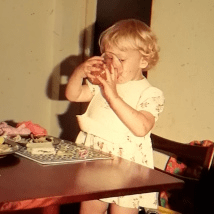
No reflection on body image would be complete without discussing food and eating. My gustatory processing works in such a way that I have very particular needs when it comes to flavours, textures, and combinations of foods. I have written about autism and food elsewhere, but in brief, I tend to prefer certain colours of food. I lack the imagination to think up original meals and tend to opt for familiar foods. My sense of taste fluctuates, and I can find particular flavours are so extremely unpleasant my body reacts as if I have been given poison!

My need for routine and familiarity (in order to calm my chaotic world) can result in restricted diets. My anxiety and sensory processing can encourage me to avoid mealtimes. As a teenager, my poor executive skills led to me being disorganised and eating quite a limited diet. This resulted in weight loss and poor health. My energy levels frequently soared then crashed in response to my unhealthy eating patterns. This probably had an effect on my emotions and self-esteem too.

Each of us will experience a complicated mix of factors all interplaying to help influence our body image. Our internal and external body awareness will give us a ‘sense’ of our bodies, and our thoughts, beliefs, and feelings about this will play a part too.

As autistic people we may experience additional influences on our bodies – in the form of our atypical sensory processing, and our need for routine, ritual, and repetition. We may intuitively know how to regulate our senses and emotions too. This may be in uniquely autistic ways. Many autistic people find repetitive movements, sounds, visual images, and other sensory input is fantastic for helping with focus, relaxation, stress relief, and joy. These activities can bring a sense of peace and predictability to our bodies and make them feel ‘safe’ and ‘connected’ to our whole self. This is certainly my experience anyway. Unfortunately, these activities may be seen as inappropriate, or a subject for teasing, scorn, or punishment.

Imagine living in a body that feels clumsily out of your control; that shifts its shape from day to day in front of your eyes; that reacts physiologically to the ebb and flow of a restricted diet and rigid exercise plan; and recoils  uncontrollably from flavours or touch.

Go back to my opening questions. Is that body a place that feels safe to you? Is it an ok place to be?  When what you ‘know’ doesn’t match what you ‘feel’, because you feel nothing but know everything – are you sure it is even you in there?

Is it surprising that so many autistic people are diagnosed with eating disorders, or self-harm, or are vulnerable to abuse? How do you even consent to another person entering the space of your body when you don’t know where that starts and stops?
Categories
5 minute read autism diagnosis identity

Aren’t we all a little bit on the spectrum?

I’ve heard this said quite a lot – particularly since my diagnosis. Firstly I’d like to say “Thank You” to the people who have said it. I mean that sincerely. This has been said to me when people have been empathising, or trying to relate to my situation – it has even been said to soften the perceived blow of having a ‘disabled’ child. I am heartened that people want to put themselves in my shoes and I hope they bear with me and read this blog; reflect on other ways they can show their solidarity, and continue in their commitment to understanding autism.

Receiving a diagnosis of autism is a complex process. The diagnostic criteria is based upon clinicians identifying certain traits, experiences and behaviours, and all sorts of biases may come into play. This may be why certain groups of people are under-diagnosed or misdiagnosed.

In my opinion, the assessment criteria for diagnosing autism is based on stereotypes and deficits and could benefit from being updated. People who don’t fit those stereotypes, or are skilled in adapting to their atypical experiences of the world can easily be overlooked. However, there are some skilled clinicians out there that understand “why” autistic people do what they do and they are able to delve deeper and unpick all the various complexities of the person’s experience and identify whether autism is in fact the correct diagnosis.

Whilst every autistic person is unique and completely different to the next autistic person, we all have one thing in common. We have always been autistic. Autism is lifelong. No one becomes autistic as an adult, and there will be evidence of autism right from the very start.

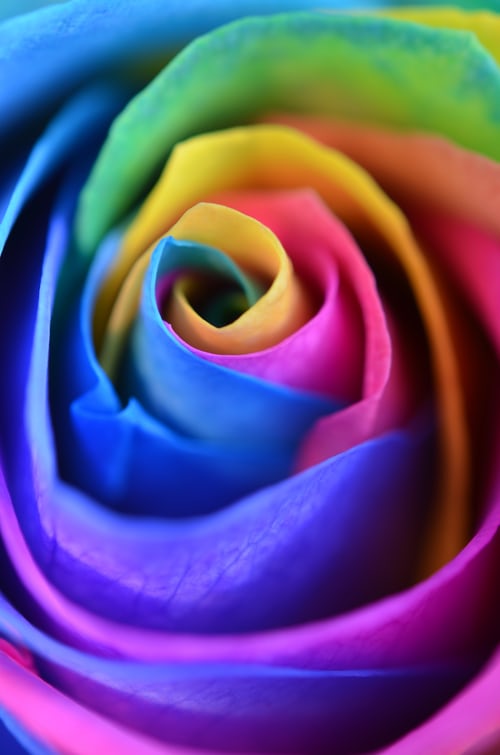
Apologies to anyone who is tactile averse. I wanted an image that demonstrated a ‘human being behind the spectrum’ – that paint looks a bit yucky though if you don’t like that sort of thing!

So are we all a little bit autistic?

No – we’re not. But we do share some experiences and behaviours. There is plenty of stuff about autism that is relatable to people who aren’t autistic. That’s why I enjoy using analogies to share my experiences.

If I described my atypical sensory processing, sensory overwhelm, and my need for adjustments in a scientific or medical way, it’s likely that you might see me as very different from you. That’s ok – I probably am. But if you can relate to a scenario such as this one then you may begin to ‘feel’ what it’s like for me as well as understanding why I’m different.

Picture this: You’re driving around in your car looking for a parking space and it’s raining, the radio is blaring out, the heater is on and you’re way too hot in the car. You’re thinking about that appointment you need to attend and what you’re going to say, and you’re not sure if you’re wearing the right clothes, and you can’t see an empty parking space. The windscreen wipers are swishing back and forth on maximum speed, and even though you are leaning forward and screwing your eyes up, you just can’t see where you can park. It’s all beginning to feel a bit much. So you turn the volume down on your car stereo and turn the wiper speed down – suddenly it becomes easier to find that parking space. You’ve done nothing to improve your vision, or the parking space detecting ability of your eyes, but the drop in volume means the overall processing your brain has to do of all that various sensory information is reduced and it becomes easier to focus. That’s similar to the level of overwhelm I often feel and why I need to have peaceful, calming environments to live in.

If you find that scenario relatable it doesn’t necessarily mean you’re autistic – but it demonstrates that all our senses work together and reducing input in one sense when we’re becoming overwhelmed may prove beneficial. It also demonstrates that when we are under pressure, sensory information may feel more acute or distressing. It gives a feel of what my ‘normal’ feels like and when people understand that, it is more likely they’ll be compassionate and accommodating rather than seeing me as ‘different’ or ‘other’. If they bump into me in town and see me starting to “look like a meerkat” as my husband and son (affectionately?!!) refer to it when I have to go into a big shop with all the lights, temperature change, music, smells and escalators, maybe they’ll not think “look at that lady acting weird, standing tall and alert like a meerkat on guard duty” but “I wonder if she is finding this overwhelming like I do sometimes and what can I do to help?”

So yes, we have things in common. But as I’ve elaborated on in an earlier blog – just because my husband has backache and is tired at the moment, it doesn’t mean he is pregnant. Or even a little bit pregnant. It just means he can relate – and that’s a good thing.

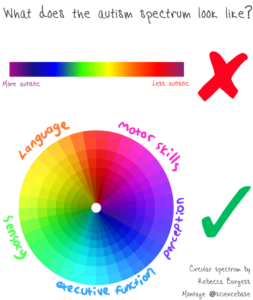
I find this diagram helpful for explaining the autism or autistic spectrum. The spectrum is not linear like the top image, it is more like the coloured wheel image below. I perceive non-autistic people as being a bit obsessed with hierarchies and linear things. I’m sure that individually people aren’t, but our society seems to enjoy ranking stuff – whether that’s a school’s league table or a football league or on a talent show – it happens all over the place. I’m a great lover of categorising things myself, but my default setting is not usually based upon the typically perceived norms of what makes one thing better than something else. It all feels a bit judgmental and you miss so much beauty in the world when you rank stuff and only focus on the “best”.

The trouble with having a spectrum with ‘mild’ at one end and ‘severe’ at the other is it’s total rubbish. Simple. You can no more be mildly autistic than you can be mildly gay. You can’t be severely human. Or a little bit on the French spectrum. It just doesn’t work like that. The characteristics and experiences autistic people share come under various categories and each person is affected differently by them. A person who has no verbal language skills with highly developed motor function will experience the world and be treated very differently to a person who is highly articulate with poor coordination. Each has their own challenges and strengths. Both are autistic and it feels difficult to say which of them is more severely affected by their autism. One can climb a mountain – one can make a phone call. How do you rank that? You begin to realise that the severity is nothing to with the person at all – but is to do with the situation or environment they are in. The social model of disability becomes far more relevant than the medical model we are more used to. The person hasn’t changed but suddenly when other people’s attitudes or their environment becomes more accommodating, they become less disabled.

Personally, I’m not too bothered when people try and relate to me by saying they are a bit autistic too. I have other battles to fight and if I tell them not to say it, I’ll reinforce that I’m pedantic. I want to build bridges between people, but I’d rather they didn’t say it though. I find it a bit annoying because it is inaccurate – and believe me, when your ‘normal’ world feels as chaotic as mine does, you need at least a few things to be ‘right’, ‘clear’, ‘accurate’ and ‘consistent’.

Many autistic people, myself included, have had a lifetime of knowing we are different to our typically developing peers. Some of us have believed – and been told – that we are ill, damaged, or wrong for being how we are. For some autistic people their diagnosis has validated their identity. For me, it has given me the freedom to be myself and the confidence to reject the incorrect labels others have given me or I’ve believed about myself. Some autistic people are loudly proud of being autistic. Hearing others saying they are a bit autistic too may feel invalidating or belittling of the very real achievements autistic people make every day in just getting by in a neurotypically biased world.

Many of my blogs end with a reflection on what we have in common. This is important to me because most of all, I am human. I have every right to exist – regardless of my neurology. My diagnosis has not just validated my identity as an autistic person but as a woman and a human being too. There is something very wrong when people wonder whether they are in fact a true human being – just because they are autistic.

I want to relate to other people and understand how their world works for each of them – I have spent my lifetime doing this and sometimes I try to copy, or pretend to understand so that I fit in better (this can be called ‘masking’ in autism, and I’ve blogged about it). I’d like people to have the same enthusiasm and commitment towards understanding the autistic world as I have towards understanding the neurotypical world. We need to recognise our shared humanity. Seeing people as “other” – whether that is in generalisations like ‘autistic people are like this’ or ‘all neurotypicals are like that’ is a dangerous road to go down. The rise of right wing politics across our planet scares me and we should take heed of what we know about how things like prejudice, stereotypes and discrimination work. Dividing people into “us” and “them” rarely leads to inclusion, equality and peace. In our own lives we can explore how to work together and see the shared experiences and use them to relate to each other better, whilst accepting we are all different and we all need different things. And that’s why human beings are so awesome!

Taken at Folly Farm in 2009 – I don’t have photos of me when I enter a big shop, but you can use your imagination and work out for yourself how I may look!
Categories
5 minute read social communication

Autism and the road to communication

Learning to drive…

Remember your first driving lesson.

“OK, put your hand on the gear stick, press the clutch down with your foot, engage first gear, slowly lift the clutch and release the handbrake and press the accelerator with your other foot all at the same time” – you’re off.

Easy, isn’t it?!

I find that the analogy of learning to drive is useful for describing how social communication frequently feels for me. Most of us who have been driving for years can do it automatically and even hold conversations with passengers and listen to music whilst taking in the road conditions and anticipating any risks or changing road conditions up ahead.

I’m one of those people. I can get in my car or on my motorcycle, intuitively find the controls and I’m off!

In fact, driving – and riding motorbikes and bicycles – are things I find extremely enjoyable. They are in the very small group of physical activities I can do without needing to consciously think about what to do with my body.

Social communication on the other hand is something that has never become automatic, and I assume that after 47 years of trying, it possibly never will. In a conversation I often feel like that learner driver I once was – awkward, painfully self-aware, and a bit clunky on the controls. I might get the order right, and use the controls appropriately, and get from A to B, but my knuckles are white from gripping the mental steering wheel inside my head so hard!

From a communication perspective I can ‘drive’ well enough to pass my test. Like many learners, I possibly have fewer bad habits than some experienced drivers. I probably know the rules of conversation better than many people – I try to be conscientious, thoughtful and considerate. But just like understanding the highway code off by heart – it’s not necessarily the way people “actually” drive. All those rules you’re meant to break – all those things that we know aren’t “real driving”… These things pass me by, and in communication situations, I often feel like a very competent learner who has passed their driving test with no major faults – but is actually not representative of most road users!

Being a mechanic doesn’t help much with driving either. My understanding of people is good, as is my knowledge of vehicles. I know more than the average person about how engines work, the sounds they make when something isn’t quite right, and the way other people drive. I can competently fix someone else’s puncture or service my own bike adequately – much as I have a good understanding of people and can help other people with their communication skills. This doesn’t help me be a better driver though; either in a vehicle or out there socialising.

When I am on familiar social roads I can begin to take in the scenery and enjoy the journey, but if you were to send me across the channel to where they drive on the other side of the road I’d be floundering. Put me in a social situation I’m unsure of and I struggle. I can do what I do, well. A bit like when I moved from Bristol to West Wales – my pulling away from junctions and roundabouts was far faster than needed and fortunately didn’t result in me rear-ending any of the local, laid back drivers that are used to having plenty of time for manoeuvres.

 I can navigate the roads of social communication, but the effort is huge because I’m usually having to consciously work out what to do unless the road is one I have travelled down many times before.  I prefer to keep my social journeys close to home and not venture out at busy times or in bad weather. We all find it helpful when other road users use their indicators properly – who hasn’t felt frustrated by someone indicating left that then turns right?! Why can’t people communicate accurately too and say what they mean and mean what they say?

I’ve been able to talk for over 4 decades and don’t fancy highlighting my social struggles with the equivalent of L Plates. I’d rather other people were courteous and gave me space and time to work out how to navigate through social situations safely and at my own pace, on my own route and under my own control. I wish that interacting with people was as straightforward as driving and I wonder why I have never got from that learner driver feeling of everything being conscious and clunky, to where I can just jump in and enjoy the ride?

Categories
5 minute read Coronavirus

Autism and making sense of the “new normal”

My  son asked me to take him to Tesco’s as he hasn’t been out in  public since March. He wanted to know how social distancing works and how our local supermarket looks.

Supermarkets are my biggest sensory nightmare – in fact, when I lay awake in the middle of the night, filled with that particular anxiety that only visits you in the wee small hours; the scenario I play in my head usually escalates along the lines of:  “You know that crap thing you did yesterday at work Emma? – Well, you’ll probably lose your job. – And then you won’t be able to pay the mortgage. – And you’ll lose the house.  – And you’ll have to get a job in Tesco’s!!!” The ultimate peak of this catastrophising mountain that I create out of a very  insignificant molehill almost always includes me internally watching myself experiencing total sensory overload whilst forced to work in a supermarket.

So I mentally prepared myself; made sure I felt regulated and  able to cope with the sudden bombardment of sensory information that would hit me and my son; took a deep breath; and in we walked.

grocery cart with item

It was tough.

I patiently explained; repeatedly, that:

“No they are not deliberately being (insert an expletive of your choice here) – there are lots of reasons why people aren’t following  the arrows”

and

“Some people may be feeling overwhelmed like us – there’s lots to think about – all the arrows, and the 2m distancing and trying to find your shopping – they possibly don’t even realise they are going the wrong way and standing too close to us. I’m sure they’re not doing it to be rude”

But inside I shared my son’s exasperation and was glad that my focus was on making the shopping trip a learning experience for him. It helped me push my own frustration, confusion and fear to one side. Afterwards he said to me “Mummy, I’m glad we did it but I don’t think I’ll do it again”. Inside I thought exactly the same.

wp-1593261389628.jpg

If the world is a chaotic, overwhelming and confusing place in the “normal normal”, then the “new normal” is something else to behold if you are autistic. I have created lots of guidelines and rules to follow that  help me get by in day to day life. Stock responses to questions; routines for doing particular tasks; time for self-care and self-regulating; almost like an internal cognitive and sensory map of how everything should be. This helps me make sense of my world and function quite well. Without my “map” I would be stuck. Unfortunately, there is another way I can become unstuck, and that is when someone changes everything around. Suddenly my “map” is of the old normal and not the new one.

My brain and body want to operate in  the familiar – that is what they are programmed for, but the familiar has gone. Have you ever driven somewhere unfamiliar and relied on a Sat Nav? You experience a diversion due to roadworks or an accident, and suddenly you have to digress from your route and you realise that actually, you have no idea of where you are and how to get back on to your route and continue towards your destination. The Sat Nav keeps ordering you to do a U turn when possible and wants to keep sending you back to that closed bit of road you can’t go down. You can’t re-programme your Sat Nav because you are driving and you have to keep going forwards, not knowing  if you are getting nearer to, or further from your destination and as it is all so unfamiliar, there’s no way of finding out.

That sense of being lost happens to me frequently. If I didn’t programme my social “Sat Nav” that tells me how to interact with people appropriately I’d be constantly lost. If I didn’t “map” how places should look, smell and sound I’d have no idea if I was in the right place, doing the  right thing.

Looking for her ball

Other animals use “maps” too. My dog’s map is very definitely based on smells. She  recognises when other dogs have been on “her” favourite walk, and she often indicates to me where a fox may have crossed the track and is very helpful in identifying potential sites for my trail camera.

Migrating birds are able to sense the earth’s magnetic field and that’s how they can return directly to the same summer and  winter destinations every year without fail. Humans in fact have the same physiological adaptations as these birds, and I wonder whether that’s why some of us have a better sense of direction than others – perhaps the sense of magnetoreception that is found in some other animals is present in humans too?

All humans use our senses to help us know where we are in the world. But senses don’t work in isolation – they are closely linked to our memories and emotions.  Perhaps your child cried their eyes out when you washed their favourite cuddly toy because it didn’t smell right anymore. Maybe the taste, smell and texture of rice pudding takes you straight back to your school days and the dinner hall and all the associations you have with that.

Autistic people often have atypical sensory processing, which means we may need more or less sensory input than other people do. We can be hypersensitive and experience a normal television volume as deafeningly loud or we may be hyposensitive and not get dizzy from spinning round as fast as possible on a roundabout. This sensitivity varies from person to person, sense to sense, and moment to moment, and often becomes more extreme in times of stress, when adrenaline kicks in and starts triggering that fight, flight or freeze response we all get from time to time.

I expect places to smell, look and sound a particular way. I need them to, so that I know how to interact with them. When things change, I feel unsafe because the predictability and familiarity has gone. My map and rule book may as well be thrown away and I have nothing to replace them with. That is why I can become overwhelmed in certain situations – it’s not about disliking change, or needing routine because I am some type of control freak (and with a nod to any control freaks reading this – I personally can’t see why being a control freak is such a bad thing anyway!). I can only function by preplanning how to do things. Knowing what to expect is a great help with this. Whether that is planning a routine for my day, or having an agenda for a meeting in  advance, or rehearsing in my head how to handle a situation – it all helps me function and thrive. My sensory “map” helps too.

wp-1593264184497.jpg

Sense of sight.

I love that I spot the finer details that others miss – like the hairs on these newly unfurled beech leaves. I can proof-read written work quickly and accurately because mistakes jump out at me. Unfortunately, this also means I can’t ignore or tolerate things that are out of place. Someone else rearranging my things very slightly, does not annoy me because they look a little bit different. It annoys me because they look completely and utterly different and like a totally different thing that I have to learn about from scratch all over again! In these Covid 19 times – if you wear a face mask then you don’t look like you and I will probably not recognise you. I am the person who thought she had a new colleague at work and went through the painful small talk and introductions process a second time with someone I had already done it with – they had just had a new haircut that’s all!!!

Smell.

This is the sense I am currently struggling with. It is a sense that connects straight to our emotions. People smell different at the moment and this is unsettling. They are leading different lifestyles (maybe they are working from home, have changed their diet, are exercising differently and have different stress and other hormones raging through their bodies). They smell more strongly to me because I’ve got used to avoiding them! This double whammy of ‘different’ and ‘stronger smelling’ makes going out feel very overwhelming. When people smoke, and wear perfume/aftershave then it all becomes too much to process and I feel myself switching off in order to cope or becoming so overwhelmed I can’t think or talk in words.

Hearing.

Although my house is rarely quiet – I have a teenage son who enjoys making a lot of noise at times. I can control the amount of noise coming in to my ears and brain, to some degree. I can wear my noise cancelling headphones and the noise in my house is fairly predictable – although the thunderstorm the other night made me almost jump out of bed! In town, the noise comes at me from all angles. Sudden alarms; shouting, laughing and talking; traffic noise and so on. The cacophony of noise is like a solid wall of sound that hits me full on and I can’t distinguish the bits I need to listen to.

My other senses are also affected by the “new normal” and its not a specifically autism related issue. Plenty of people are finding car journeys are making their children feel travel sick – normally they are fine, but they’ve got out of the habit of traveling in a moving vehicle. Many of us are enjoying the peace and quiet; we’re finding the reduction in social pressures has been a relief and a break from the high intensity lives we often lead.

Many of us will find the lifting of restrictions challenging and they will take some getting used to. All of us have different sensory preferences – regardless of our neurology. Some of us will find the fluorescent lights in shops way too bright and distressing when we start visiting towns again. Some of us will feel anxious when travelling because everyone seems to be driving so fast. On top of this are the social distancing rules – and the way they change, and some people disregard them. I have made my own rules for coping with this:

  • Safety First! If someone comes too close to you in a shop, it may be best to move away from them even if you were there first. They may not have noticed how close they were, they may have difficulty judging distances, or they may not care. What is important is that you are as safe as possible.
  • It is OK to feel annoyed. It is reasonable to expect other people to follow rules.

I am taking this step by step. The sensory processing aspect is difficult for me – I’m dreading the day we are allowed to hug people again – what if someone wants to hug me and I flinch? What if they touch my bare skin, and they smell of perfume and I can feel their breath?!!! I don’t want it to be noisy and bright and smelly. I want it to be the same and predictable and familiar and I think I’ll stay in and just go on the internet and write, and message my friends from a safe distance! I can’t predict how this “new normal” will look and I’m out of practice with doing people things. When I do interact with people I remember why I find it tough – they overstimulate my senses, and confuse my brain with their inconsistent rules, they have hidden agendas that I don’t intuitively understand and I am reminded at how I’m just not very good at being a normal person! After spending time away from my own little world at work or visiting a shop, I am exhausted.

Hope…

But I will continue with the self-care and show myself the same compassion I have used towards myself throughout lockdown. I am not alone in feeling anxious and overwhelmed about this. I am relieved the restrictions are being lifted little by little. I can get used to the “new normal” little by little too.

The kindness and positivity seen in society at the start of lockdown has appeared to shift into anger and disregard for others. I hope it is just because people are fed up. Maybe everyone is scared by the changes? As lockdown eases, I am glad that I have coped and got this far. The world is going through unprecedented times and who knows what will happen next. I have learned so much about myself and how resilient I am and what I need to do to take best care of myself and family.

The bits of lockdown that I have most enjoyed, I will continue to do. My Saturday morning baking, my walks in the woods, the friends I message and spend time online with. I will continue to write the blog that I started in lockdown, and I will continue with being kind to myself and others.

Maple, pecan and apple Bakewell – my invention this morning!