Sending you all my best wishes…here is a blog I authored for NeuroClastic
Categories
Sending you all my best wishes…here is a blog I authored for NeuroClastic

I contracted Covid-19 for the first time in April 2020. This required a hospital visit which led to my interest in developing resources to support other Autistic people and their families as part of my professional work as a director of Autism Wellbeing CIC.
I received my two doses of the Covid vaccine during the summer of 2021 and was unfortunate to become infected with Covid-19 for a second time in October 2021. My symptoms of early illness did not present in the expected way.
My most recent Covid-19 infection initially resulted in the common symptom of complete loss of my sense of taste and smell. I have regained about 5% of my olfactory and gustatory processing ability six weeks on from infection.
My professional career has been within social care – developing and delivering services to people who are labelled as having complex needs. My own experience of Covid-19 enabled me to reflect upon some of the potential impacts this could have on other Autistic people, and in particular those who use non-verbal communication or are considered to have “challenging behaviour”.
Prior to both infections with Covid-19 I noticed a complete change in my demeanour. I did not feel ill. I did not feel hot or cold – although a thermometer indicated I had a fever. I experienced the sudden onset of severe depression-like symptoms. Fortunately, I am aware of how my interoceptive processing experiences manifest. Interoception is the sense we use to process internal body signals such as pain, hunger, or needing the toilet – and to notice our emotions and the changes they are creating in our bodies (racing heart could mean excitement or anger for instance).
The severity of the depression-like symptoms frequently overshadows my attempts to seek medical help for my physical illness. When I seek medical intervention at these times, my physical illness is typically overlooked, and my mental health is scrutinised – despite me articulately and accurately informing medics that I believe I am coming down with a physical illness. This overshadowing of my physical illness due to putting greater emphasis on the risk management or identification of my depression-like symptoms may prolong my illness as my physical health problems are not treated. It invalidates my experiences and may even create barriers to me seeking support or communicating with medics.
When I consider people I have supported professionally, that are labelled as having “challenging behaviour”, I recognise occasions where perhaps they too may have experienced a sudden change in mood due to a physical illness. Within my work I have observed people exhibiting behaviours such as shouting; biting themselves or others; or running away. These behaviours were considered to be caused by the person trying to communicate that something was wrong and as practitioners we would consider whether this could be something external such as too much noise or the person not wanting an activity to end, for example; or something internal such as toothache or illness.
At times, “challenging behaviour” was interpreted by some practitioners as having an element of intent or wilfulness on the part of the Autistic person. It was sometimes considered that the person didn’t know how to communicate “properly” using speech or sign language or had poor social skills – and therefore chose to demonstrate their pain/distress/urge to leave, by “acting out” and using their behaviour in a planned or possibly even manipulative way to communicate with others.
Where no cause or trigger was obvious to the (usually non-autistic) observer, it was common for the observer to conclude that the person was over-reacting or hyper-responding in some way, and subsequently needed to learn more appropriate coping strategies. My own symptoms of sudden severe depression could look like emotional instability to an observer, and they may well consider me unable to cope with being ill. They may misconstrue that my mood symptoms are a response to my physical illness and not the way that illness manifests for me.
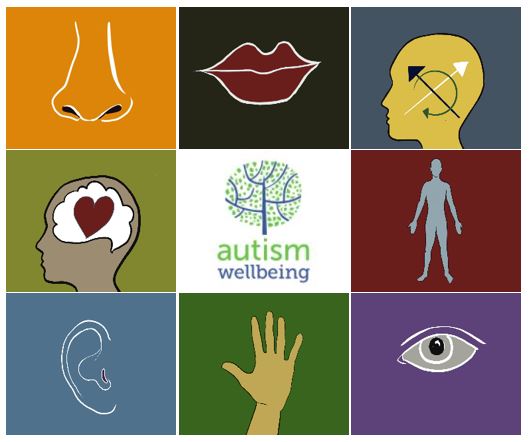
Sensory processing is the process by which the nervous system receives, organises, and understands sensory information. All of us experience the world through our senses and our brains process this information.
Autistic people frequently process sensory information differently to non-autistic people. Our sense receptors (eyes, ears, taste buds and so on) may work perfectly well but there may be differences in the way our brain processes the sensory information. This may include struggling to process too much sensory information or filter out unnecessary information; experiencing heightened, muted, or distorted sensory signals; delays in processing; or perception in one or more senses shutting down, resulting in an incomplete picture of what is happening within the body.
Each of us has a unique sensory profile. But sensory processing does not happen in isolation. Our sensory experiences change and can appear inconsistent to others who do not recognise the dynamic and context specific nature of sensory processing.
Our senses play an essential role in keeping us safe. For example, if food smells rancid, we know not to eat it, and if we feel unstable on a structure, we climb down from it. Sensory information tells us how to act in and adapt to the environment. Sensory processing also plays a role in regulation, activating us to evade a threat or calming us so that we feel safe.
My sensory experiences following Covid-19 infection have reminded me how our senses work together and not individually.
The role of our senses in keeping us safe is significant. Risk taking may not always be due to recklessness, impulsivity, or lack of understanding of risks – it could occur due to sensory differences.
Autistic people may experience the world in a disorganised or chaotic way because our senses work so differently. My typical need for routine and structure reflects this. Since Covid-19 infection, I am aware that I am relying even more than usual on timers, reminders, and routines in order to compensate for my loss of certain senses. To an observer, Covid-19 may appear to have made me “more” Autistic. It hasn’t; but my “normal for me” world has changed, and I am needing to find security, certainty, and predictability in this new world of minimal smell and taste.
If I was supporting an Autistic person who was not able to articulate their experiences, and they had recently tested positive for Covid-19, I would consider how their sensory processing may have been affected. It would not surprise me if some Autistic people needed to increasingly rely on their other senses to make sense of the world if their sense of smell and taste reduced. They may touch things more to identify them using their tactile sense. They may stim more in order to get extra vestibular and proprioceptive input. I’d expect to see more tasting and smelling of items and people; and possibly increased frustration at not being able to recognise them by these methods.
I would also expect to see an increase in repetitive questioning by some Autistic people. I too have a felt a need to check and recheck information in order to seek out familiarity and predictability. I have found satisfaction in the predictable to-and-fro of scripted or familiar conversations and exchanges. Those reliable quotes from films and songs that stay the same each time you hear them! Similarly, I would not be surprised to see people stuck in a loop of thinking, or stimming, or behaving in a particular way – these tendencies are often exacerbated by change and unpredictability and can provide predictability and a self-soothing function.
Moving forwards, I have prepared myself for a potential return of my sense of taste and smell. I am aware that just like the effects of the various lockdowns ending; a sudden increase of sensory information may be too much for my brain to process and result in survival responses of fight, flight or freeze. I plan to stick with my mindful approach to noticing what my senses are picking up, with no judgment and a curiosity that will hopefully enable me to reflect and share my insights.
I encourage practitioners to consider sensory processing experiences when supporting Autistic people whose behaviour suddenly changes from what is usual for them, and perhaps check whether Covid-19 infection and symptoms related to loss of smell and taste may be the cause.

In recent weeks, the largest ever UK autism research project, Spectrum 10k, was paused and an apology given to Autistic people, their families and charities that support them. The ubiquitous Simon Baron-Cohen, endorsed by several celebrities had declared how this research would investigate genetic and environmental factors that contribute to the wellbeing of autistic individuals and their families. Questionnaires and saliva DNA samples were to be used to learn how different genes are associated with autism and co-occurring health conditions.
Who wouldn’t support research that has the potential to reduce some of the health and wellbeing inequalities faced by Autistic people which, after all, are numerous and considerable?
Well…. A large proportion of the Autistic community don’t support the Spectrum 10K research in fact! A Twitter poll #AskingAutistics posed the question “What’s your view on Spectrum 10k?” The 582 respondents voted:
Fantastic 1%
Not Sure 17%
Awful 82%
Social media pages came alive with comments, questions, anger, fear, and objections about the way that so many autism research projects are undertaken. However, Autistic voices were repeatedly “shushed” and valid concerns about eugenics were mislabelled as conspiracy theories.
It may be helpful to understand a little about autism, about autism research, and about how autism is perceived.
Autism is a neurological variation, a naturally occurring expression of human neurodiversity. Autism is lifelong, and Autistic people can be of any gender or race and have a wide range of cognitive abilities. Autistic people almost always experience sensory information differently to non-autistic people. This means they process the world very differently to non-autistic people and subsequently have a different way of being in the world. I have spent 25 years working in the field of social care, and I am currently a director of Autism Wellbeing, a small non-profit organisation. I am undertaking PhD research about perceptions of autism, and my previous postgraduate research was about the effectiveness of mental health outcomes monitoring tools.
A review of autism research funding in the UK was carried out in 2016 by Autistica – the UK’s national autism research charity. The most common research areas were about the biology of autism; its causes; and autism treatments. Spending on autism research had trebled between 2013 and 2016.
Yet despite all this research, autistic people experience poor outcomes compared to their non-autistic peers in a range of life domains. Knowing about autism doesn’t necessarily improve outcomes for autistic people. When it comes to mental health, autistic people are more likely to die by suicide, are more likely to self-harm, and are more likely to experience mental illness than non-autistic people. Autistic people face barriers to seeking psychiatric treatment and as I discovered in my own experience as an Autistic person, misdiagnosis can often occur, and autism can be missed – with devastating effects.
Key findings of a report into UK autism research highlighted that academics perceive themselves to be engaged with the broader autism community, but this perception is not shared by other stakeholders, most notably autistic people and their families. Autistic people see the challenges of autism as societal and attitudinal and not about ‘curing autism’.
Autistica led a James Lind Alliance Priority Setting Partnership, that asked over 1,000 people for their top questions for autism research. These were then ranked in a final workshop attended by autistic people, parents, and professionals. The number one priority was about mental health and autism. Nowhere within the top ten was any mention of understanding the genetics or biology of autism.
Very few studies have been completed about perceptions of autism, or attitudes towards autistic people. Research seems centred on fixing autistic people rather than improving society. Like many other Autistic people, the challenges I face are better explained by the social model of disability than the medical model. I do not feel that a better understanding of my genetics will reduce the barriers I face every day as an Autistic person.
My PhD research sits within the field of social science and my presentation recently won the WISERD PhD poster competition: “I feel like a square peg in a round hole: How is autism perceived and does it matter? – An exploratory case study into perceptions of autism within a Community Mental Health Team”.
In academic literature there is a disconnect between autism as a condition and being autistic as an experience. Autism is seen as a medical disorder and so attracts a disproportionate amount of research interest and funding – you could even say it is a research topic that keeps on giving. As an essentially narrative condition diagnosed on the subjective opinion of clinicians, autism is susceptible to ceaseless and sustained interpretation and reinterpretation. According to the prevailing science based, medical, cognitive interpretation of autism as involving a lack of theory of mind, autistic experience itself is a “black box” and hence not susceptible to investigation, let alone interpretation. Perhaps this relieves researchers of any felt obligation to interrogate either their own perceptions of autism/autistic experience or anybody else’s.
My PhD research question took a while to materialise. I considered a number of research topics, all related to autism; and time and time again, I kept coming back to the same concept. No matter how much we know “about” autism – Autistic people still experience poor outcomes. Perhaps the issue is not about something that is “wrong” with Autistic people, but something that is wrong with the way Autistic people are perceived and consequently treated. As my research question materialised, I realised that what was missing from the research was not “what is autism?” or “which gene causes autism?” but “how is autism perceived?” I believe that by exploring this area of research, outcomes for autistic people may be improved.
I believe it is time for researchers to collaborate with Autistic people and together take a look outside of the bodies and brains of Autistic people and into society, to see how improvements can be made.
It was wonderful to spend some time with Chloe discussing Sensory Trauma. Why not catch our interview on YouTube

Spectrum 10k research – there is a link at the end of this short blog. This blog is entirely my personal opinion.
I have needed time to process this research and what it means to me. My initial thoughts were complex – I felt conflicted and confused.
I totally stand by the researchers wanting to improve outcomes and wellbeing for autistic people.
I totally stand alongside every other parent who sees the struggles their autistic child faces every single day – and would give anything to improve that.
I don’t have an understanding of how DNA and uncovering which genes cause autism will improve autistic people’s lives. I look at other genetic conditions that we understand better; like Down’s Syndrome and compare the options…I am not filled with confidence. I would like to understand more.
I appreciate the fear of eugenics. The reality of whether genetic tests will be used to eliminate Autistic people – or simply the bits of Autism people don’t like – or even the co-occurring conditions only – is something we are unlikely to get a truthful and long-term answer to. The reality of eugenics may be cloudy – but the fear Autistic people are expressing, is tangible and totally real. Yet Autistic people’s concerns are being minimised, invalidated, and spoken over time and time again. Autistic people are being tone policed for their communication-style differences, not listened to, not taken seriously, nor respected.
My need for self-care has meant that I have chosen not to get involved in dissecting the methodology, ethics, and motivation of this research at the moment. But a quick background search on the institutions, funders and past research topics has rung alarm bells for me.
What concerns me most with the launch of this research is the way that it was done:
The lack of awareness of how Autistic people may feel about it.
The lack of compassion and empathy.
The lack of foresight.
The missed opportunities to collaborate meaningfully and take people with them.
This irresponsibility has been divisive and enhanced mistrust.
Some Autistic people are quite rightly distressed by this research, yet this does not seem to have been factored into the research – support was not set up alongside the research, to help manage the inevitable and very real concerns people would have. Yes, the researchers have answered questions – but have they even considered the emotional fall-out – and how that may be experienced by Autistic people (who process information, sensory input, including emotions – differently to non-autistic people). Do we feel cared for, nurtured, and looked out for by these researchers?
My initial thoughts were complex – my current thoughts have moved on but are equally complex. I see research with stated good intentions, that also reminds me that given the choice, some people would prefer it, or think it for the best if Autistic people, like me, did not exist. I am significantly deficient enough that they should be offered the choice about which parts of me are useful enough to be allowed and which bits to get rid of.
My genetics and neurology make me – they make me different to the majority, but I am me, and equally valid. I have a right to be here warts and all. Let’s fix society first.
Autistic people are more likely to experience mental health issues – and most will tell you that this is down to how we are treated and the barriers we face – not our inherent so-called deficiencies.
Many autistic people feel ashamed of our differences – we are more likely to experience abuse, be out of work, struggle with education. We frequently mask our autism – not because we want to fit in – but just so that we are allowed to take part. We may struggle with our identity and feel ashamed.
But it is not for us to be ashamed. Every single human has a right to be here. No one – I repeat – no one person has zero physical, mental, emotional, learning, social or other issues. I have struggled with my own sense of worth throughout my life – and I want to say to other Autistic people.
You are welcome as you are. You don’t need to feel ashamed.
Shame on those who say otherwise.
UK research has predominantly focused on the biology, causes, and treatment of autism. Key findings of a report into UK autism research highlighted that academics perceive themselves to be engaged with the broader autism community, but this perception is not shared by other stakeholders, most notably autistic people and their families. Autistic people see the challenges of autism as societal and attitudinal and not about ‘curing autism’.
CRAE, 2013. A future made together: shaping autism research in the UK, London: University of London.
Non-autistic allies – please take a moment to let the Autistic people you know – and those you don’t too, if you feel inclined – that they are valuable as their whole self. This is a message rarely heard by Autistic people.
Thank you for reading.
https://www.crowdfunder.co.uk/crowdfunding-to-help-autism-wellbeing-bounce-back

Time and time again I read and hear how autistic people camouflage their autism so that they are more able to fit in. This makes a huge – and rather arrogant assumption – that we want to fit in – that we don’t want to be autistic.
I can only speak for myself but would like it on record that this is certainly not the case for me! The photo above is of a Speckled Wood butterfly, camouflaged against the woodland floor. This butterfly does not wish to “become” the woodland floor, nor does it want to stop being its authentic butterfly self. It has one reason for camouflaging and one reason only – to avoid predation.
Autistic people mask or camouflage their autism for many reasons; and frequently report the devastating impact of this on their mental health and wellbeing. Autistic masking is more than the reputation management and social niceties most people use every day. It is not simply about fitting in – often it is about avoiding bullying, discrimination, reduced opportunities or downright harm – predation even!
The framing of autistic camouflaging as a means to fit in, invalidates the lived experience of many autistic people. It fails to take responsibility for the discrimination and abuse directed towards autistic people. Until society accepts responsibility for the way autistic people are treated and changes this to become more positive, autistic people will need to protect themselves by masking their autism.
We may wish to take part – but this is not the same as “fitting in”. We may even be invited to join in – but frequently this is tokenistic. Inviting me to a place that I cannot enter because of my needs, but refusing to change it so I can enter or take part, is not inclusion.
I’d like to reframe the idea and commonly accepted use of language about autistic people camouflaging in order to “fit in” – and suggest we use the words to “take part” instead. It is a subtle change of language but the former suggests that those “others” want to become the same as the majority. Whereas “taking part” allows people to retain their identity whilst still belonging to the whole group.
Disabled people should not have to pretend we are not disabled. I would never expect my colleague who uses a wheelchair to put his chair to one side all day at work, because after all he can walk a few steps when he needs to. I would never tell him that I saw him walking a short distance the other day and he looked like he was doing it really well so why can’t he go without his wheelchair all the time? I certainly wouldn’t suggest that we all have to put up with things we don’t like and if we let him use a wheelchair, everyone will want one!
I will no longer be referring to autistic camouflaging or masking as a strategy used to better “fit in”. I shall tell it like it is. There are no excuses. Until society accommodates autistic people and stops the discrimination, mistreatment and abuse so that I can “be” autistic without needing to hide, I shall remind people that they play an important part in my need for masking; and they need to stop!

This brief piece was prompted by a number of discussions I’ve had with people about autistic masking, being authentic and true to your autistic self.
You may like to check out my writing about autistic masking via the menu.
I’m autistic, so experience the world differently to non-autistic people. My senses work differently – my personal range of sensory experiences is broader than most non-autistic peoples’. I experience some things more intensely (e.g. sound and smell) and others less intensely (e.g. body sensations and balance)
I have less need to form hierarchies than many of my peers – I still love to organise things and compartmentalise them, but we use different systems.
I think about things differently. I tend to consciously think through things that many others find intuitive – and intuitively know things that others have to think about!
I am in a minority. A seriously misunderstood minority. This means I often have to hide things like the extent of my sensory overload or my need for clarification.
My logical and literal mindedness puzzles people. My drive for clarity and need for honesty perplexes them.
And often it is NOT a problem. I have integrity, I cannot tolerate inequality. I stand up for what is right regardless of the personal consequences.
It becomes a problem when I remain dysregulated because I cannot do what I need to do to be in a state where I can learn and thrive. None of us can. But for me, the sensory aspects of the environment – and inside my body (noise, smells, lighting, my emotions) tend to effect me more because my sensory processing works differently.
Being dysregulated always makes thinking, communicating, and looking after myself and others needs, more difficult. That’s the same for all of us.
Humans are social animals. I don’t particularly enjoy socialising and I certainly find humans difficult to understand, but I recognise my social responsibilities. I may not want to hang out with other people for fun – but I choose to have unconditional positive regard for them….. and in fact, some of them are actually quite nice!
When I was younger I would be blunt, straight to the point and say exactly what I thought. I knew I was right. I certainly didn’t aim to be rude. In fact, I thought I was doing people a favour by leaving the bullshit out and getting straight to the point! I saw no need for small talk. I empathised by finding common ground that demonstrated my understanding of the other person’s situation and shared this with them. I used my incredible capacity for problem solving to offer advice, find solutions and share them with others. I wanted to be helpful. My heart was very definitely in the right place.
I sometimes came across as rude, self-centred and insensitive.
I am not.
Reflecting on this, it is important to consider that other people don’t necessarily operate in the same way as me. Those sensory and cognitive experiences I listed earlier may be different.
When I appreciate this, I realise how invalidating my responses to others may be. Lets take empathy as an example – a subject I have written about in my personal blogs and for Neuroclastic.
My natural, authentically autistic response to someone telling me something distressing about their own experience is to trawl through my memory for something comparable.
I don’t feel a lot when people share their experiences with me. Other autistic people may be somewhere else in this broad range of sensory experiences and physically feel other peoples pain to such an extent it hurts them too. If I responded with a “yeah well, whatever” to someone’s loss, and my autistic friend with the intense emotional sensations responded with a “omg, that is so awful – look I’m crying too” – neither of us would be much use to the person who was choosing to share their experience with us.
So I developed a technique that uses my very natural abilities of logic and reasoning. I would find something comparable from my own life and tell them about it so they realise that I truly understand.
Except they don’t!
Of course, these genuinely autistic responses can be seen as invalidating for others. And it’s not just issues around empathy where this happens.
If I was to tell someone that they looked dreadful in their new dress when they asked me for my honest opinion, they’d likely be hurt.
I hate lying and I find the games people play where I am meant to know the hidden meanings behind questions, frustrating and disappointing. I am lucky to live in a family where we can be open and honest and not dress things up in untruths.
As I have matured, I have found ways of remaining authentically me, whilst recognising that other people may be running on a different operating system to the one I’m running on. Expecting other people to appreciate my straight talking just because I’d like them to do that for me, is a non-starter.
I could simply say “I am autistic, I have every right to be autistic and this is how I do things” and expect them to accept this. But they won’t! People don’t. Maybe one day when people understand autism better they will accept our way of being a bit more. In the meantime, I do have people that I can be more blunt with, or skip the small talk. It’s great and is a very small step on a long journey to equality.
Or I could mask my differences and pretend that I am like them too. That I enjoy small talk, that I like to beat around the bush rather than get to the point. That I am happy to lie! But that sucks, and messes with my mental health. I sometimes need to mask my distress and dysregulation in order to feel safer and to blend in – and we all need to behave differently in different situations in order to act appropriately. But long term masking erodes your wellbeing and identity.
The most important consideration goes back to my thoughts on how I treat others – and myself. Unconditional positive regard. Not being an asshole to others or to myself! Recognising our differences and accepting them. Using my desire to find common ground, but not in a way that invalidates other people’s experiences or takes from them and puts the focus on me instead. Not needing to change people, instead accepting them as they are.
I recognise that I am in a neurological minority. The majority of people tend to assume I am like them, because my differences are not usually visible upon first impressions. They should accept me for being me and for being autistic, but they usually don’t.
I want them to treat me in the way that I treat them.
When I am talking with someone that has a different way of being in the world to me, I try and understand how it is for them. Many autistic people do this – it is what makes us so great at masking and camouflaging our autism.
I still use my particular way of empathising to consider that the other person may get an unbearable sensation if I tell them honestly that their dress looks awful on them. Just like I sometimes get an unbearable sensation when I have to make small talk. I consider that they may find our surroundings drab and insignificant and easy to filter out – whereas I am annoyed by the background noise and distracted by their perfume. I hold on to the fact that we are operating on different systems. But I don’t necessarily say all this out loud.
I cannot get them to understand my way of being by forcing it upon them, just like they cannot get me to become less autistic by forcing me to enjoy soap operas and small talk! Nor can I bully them into changing their attitude by blaming or shaming them for simply being born different to me. Nor should they try and bully or “normalise” me or my autistic peers by making us keep still instead of stimming; or keep quiet instead of asking for the clarity we need.

I would love non-autistic people to put the same amount of effort into understanding autistic people that autistic people often put into understanding them.
If I am going to accept that I need to be diplomatic when telling you about your dress, so that we maintain our positive relationship and you don’t feel hurt; then I’d like you to reduce the amount of effort you unknowingly make me use when trying to understand your true intentions and desires when we are chatting.
We both need to recognise each others intentions – and we may need to get to know each other and see beyond the stereotypes in order to do that.
Autistic people often communicate really well with other autistic people – we clearly don’t have deficits.
When you know me, you will value my honesty. Don’t write people off because they say or do things that seem odd to your way of thinking. If I accidentally upset you, remember that my intentions may not have been the same as your intentions in the same circumstances – and I’ll try and do that for you too.
I will not compromise my values, but I’m happy to adapt my communication style to accommodate you – in fact I do this most of the time already! Please do the same for autistic people.
Here is a blog I wrote that NeuroClastic recently published.
There is a fantastic breadth of autistic experience available on the Internet. Neuroclastic.com is a great source of insights. Why not check their website out, and have a read of my latest blog while you are there.
I was prompted to write my first blog when I saw the frantic rush by shoppers to buy toilet roll. It triggered my own anxiety about what would happen if panic buying resulted in me not being able to buy the very specific brands of food that I must have.
The world did not run out of toilet roll, pasta, crunchy nut cornflakes or any other items and my anxieties about shortages were unfounded.
However – my distinct lack of anxiety about the potential impact of coronavirus on my health – I believed I would be at low risk due to being healthy and unsociable – was proven completely wrong.
I did become ill in the weeks following writing my original blog and needed to visit the hospital due to my continuous cough and breathing difficulties. This hospital visit was unlike any hospital visit I had made before. Some positives came from it and I was able to share my personal experience of sensory distress and confusion with the health board who were developing some fantastic resources for people who have a learning disability or are autistic. I’m glad I could use that traumatic experience to help others.
I worked as a key worker until late August and also in my role within Autism Wellbeing. We began producing information for people affected by autism. Tips for autistic people; their families; carers; and colleagues; covering everything from the language used in the pandemic; masks and PPE; coping with change; self-care; returning to work and school; and coping with the “New Normal”.
Our popular Covid-19 Resource pack has been widely shared and downloaded. You can get a free copy by following this link:
https://www.autismwellbeing.org.uk/product-page/autism-wellbeing-covid-19-support-pack
In fact, we were nominated for and awarded as “Local Lockdown Legends” for the work we are doing online and in our Facebook peer support groups for autistic adults and for parents/carers. (And by the way; many group members are in both groups).
At home we focused on our son. He was already home educated and I watched how parents of school educated kids tried to juggle working from home with providing a full time education. An impossible task. Collectively across society, we all did our best and realised there were many benefits to the computer screens and games consoles we often feel as parents are ‘taking over’ our children’s lives. The ability to chat online and out loud to friends, to play games together and stay in touch from the privacy of our own homes is invaluable and has been a life saver for many people. Here is a personal post I shared on Facebook as the first UK lockdown was announced. And a follow up 2 months later:
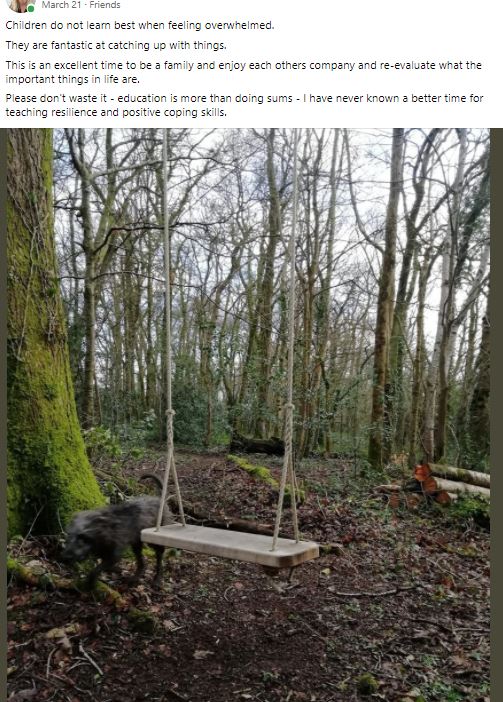

We are still learning about what is important to us. We have found that routines work well – and letting each family member set the routines that are most important to them is even better. I tend to bake a cake each weekend, we have pizza and a film on a Saturday – we have found that making the weekends special is important for us so we don’t feel lost in a world where every day feels like Sunday.
My initial fear – in fact it was more like a recurring bad dream, was of the pandemic ending abruptly and the streets being filled with people making lots of noise and desperate to hug me – imagining this filled me with terror. Of course, this is not how it has panned out.
I am so lucky, I live in a beautiful place. The natural world has been my escape, my place of solace, my predictably changing best friend throughout the pandemic. I have watched the bare branches of the beech and oak trees in my local woods fill with leaves until the woods became darker under the shady green canopy. And now, they are almost bare again under the steel-grey autumn sky. I have seen wood anemones make way for bluebell and the foxgloves. The Red kite I began observing on March 13th probably nested and raised chicks – but I’ll never know – my blog diary was never finished due to travel restrictions. I satisfied myself with writing about the history of Red kites in Wales instead. Here’s a link to my wildlife blog below. I also continued to write a nature column for my local newspaper as well as running my wildlife Facebook group.


Our family also faced challenges. Being unable to visit a parent who was rushed into hospital on two occasions during lockdown – not even being able to find out what was happening due to confidentiality rules, was upsetting and frustrating and left us feeling helpless. Not being able to meet as a family to lay another family member’s ashes to rest and pay our last respects was tough too. The uncertainties of the pandemic were topped off with the uncertainties of family life.
And on top of this my husband and I have post viral fatigue. Long Covid is what people are commonly calling it. I have had swollen joints, shingles, urine infections, breathing difficulties, and tiredness like you cannot believe. I have barely enough energy to keep myself feeling regulated and my sensory processing has swung from hearing every noise, finding daylight painful, becoming nauseated by any smell – to – not feeling a thing, not knowing where my bruises have come from or finding my hair is matted from where I have rocked unknowingly and continuously all night long in my sleep.
I have felt confused, scared and bewildered. I initially felt annoyed that people were clapping for the NHS – mainly because I like peace and quiet and the sound of my neighbours beating the hell out of saucepans every Thursday evening left my body activated and ready for flight, fright or freeze from the moment I got out of bed on a Thursday morning. I now wish that society was still coming together in this way – the sense of us all being “in it together” has diminished. People are calling other people out for perceived breaches of lockdown and are jumping on bandwagons they had no interest in before. I watched friends throw every ounce of their energy into campaigning about “Black Lives Matter” – my sentiments are with them all the way but it felt like this and other topics were being used as a distraction from the boredom, worry and upheaval of the pandemic; and I watched with shock, bewilderment and disappointment as I saw other friends demonstrate the most ill thought out and racist behaviour ever. I witnessed parts of society get fed up with staying in when the sun came out, so off they headed for the beaches and countryside. It felt like all the world was out of control all around me. It looked to me as if everyone was on the verge of total emotional overwhelm – people I view as level headed were sharing memes and fake news without checking for facts first – pressing “Like” or “Share” because it gave them a shot of something that momentarily eased whatever negative feelings the pandemic created in their bodies.
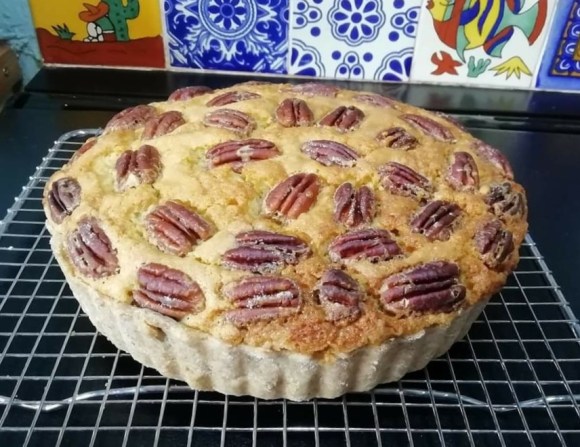
And I kept baking my cakes on a weekend, kept working, kept walking every day I could. Kept up my self-care and kept going and going and going. My ability to keep doing the same thing again and again in the same way has kept me focused and strong.
And some days I felt peace and at one with the world – I loved the simplicity, the lack of socialising, the space – and the quiet. And on other days I felt stifled, trapped and unable to find any peace – either internally or outside my body. Our one living room felt way too small for a family and I would have given anything for the endless questions about when can my son see his friends again – or the rants about what the government were or weren’t doing – or the continual noise and movement that inevitably comes with living as part of any family – to just stop!
I wondered whether autistic people would fare better than others because we are so skilled at having to cope with uncertainties. We rely on routines, structures, and rules, and are famous for preferring our own company. I wrote about how there was no better time to be an autistic person. In fact, I have a secret to share… Although my autism was never hidden, I had never articulated to the wider world what it was like for me. So I decided to write a blog because I knew I was very unwell – I wondered if I would die from coronavirus and I rushed this out so at least people would know what life was like for me if I did die. I also wrote an article for the local paper about finding peace in nature and calling for humankind to be compassionate towards each other.
Did I do better than anyone else because I’m autistic? Well, firstly it’s not a competition. We all need to play to our strengths in order to thrive in life. My strengths are by their nature autistic. Unfortunately, the medical model of autism describes them in terms of deficits and what is “wrong” with me. My need for consistency and routine, and my unique way of experiencing the world through my different sensory processing system are viewed as symptoms of a disorder. Does being autistic make the pandemic easier to cope with for me? Yes. Would it make it easier to cope with for you? Probably not. We each need to utilise the coping strategies that work best for us. But of course, there is scope to learn from each other, regardless of our neurologies…
Many of us have found we have needed to work from home during the pandemic – and many employers have embraced this and seen the benefits. Some disabled people have been requesting to work from home for years, whether due to accessibility issues that affect mobility; or accessibility issues around transport, communication and the sensory aspects of workplaces. Lets hope that those people who work better this way can continue working from home. I have been home based for many years and was able to give tips to other working people about planning your day; taking breaks; effective communication; and work/home balance.
No discussion about the workplace would be complete without mentioning video calls. I went from being someone who could not even look at a photograph of herself; to being an active participant (if a bit overwhelmed and reluctant at times!) of conference calls; to being featured in films and training videos. It was a Herculean achievement, reached by taking many painful, brave and challenging small steps. The world of conference calls highlighted many of the challenges autistic people face with communication. Not just the act of being on screen and talking to people – that can feel bad enough! But the technological issues that occur during a video call – these feel familiar to me in my face-to-face interactions:

Did I take up any new hobbies? No
Did I get fit? No….Sorry Joe Wicks…
Did I learn anything about myself, my family and the wider world? Yes, loads.
Do I feel hopeful?
I have fluctuated between feeling hopeful and feeling despair. I viewed the initial “togertherness” positively: the sense of communities supporting each other, clapping together, helping each other out. I remember a video doing the rounds on social media back in the early summer that spread a message of hope and how we’d learn and become a better society because of the pandemic. I cynically thought to myself, that we probably wouldn’t.
I watched the way the media used language, imagery, metaphors and colours to emphasise whatever mood they wanted to portray. I made accurate predictions of the government’s next moves – I’m no conspiracy theorist, or political expert – just an accomplished spotter of patterns!
I have seen people ride by on a rollercoaster of emotions, I have occasionally hopped on and off myself! A “coronacoaster” as one meme describes it.

Coming out of a 17 day Welsh lockdown today, having been on tenterhooks over the US election, fatigued by post viral illness and worried about my family and what the future holds; I could easily feel hopeless – I do feel hopeless. And that’s OK. This pandemic really sucks sometimes!
But when I reflect and look back at the positives that have only happened because I have been alive on this planet in this exact period of time, then yes, I do have hope…
 Undercover Autism