Categories
5 minute read Autism identity interoception sensory trauma Uncategorized

Making sense of feeling unsafe

A blog about mental health, emotional distress, autism and hope.

I feel like I am unravelling. Thoughts are like words outside my head. My body seems to be somewhere else. Where “I” end and everything else begins seems fuzzy, fluid, and fucked up.

Am I in pain? I don’t know.

Am I upset? Not sure.

What do I want and need? No idea – and please stop asking all those difficult questions!

I’ve had a tough few weeks that culminated in a car crash a fortnight ago. The hospital scans show that thankfully, I have no broken bones. My bruises reveal I am injured. My sensory processing indicates something is very, very wrong and I must prioritise self-care.

The one question I can answer is “Do I feel safe?”

My answer is a resounding “NO!”

My lived experience of mental illness, emotional distress and sensory processing differences, is one of fear, uncertainty and feeling very, very unsafe. As an autistic person, my experience of the world tends to be chaotic and unpredictable at the best of times and when I factor in traumatising events, illness and injury, the chaos goes up a level!

Sensory Processing

All of us experience the world through our senses. In addition to the five senses that are involved in processing sensory information coming into our bodies from outside: touch, taste, hearing, sight, and smell, we have three more sense systems: our proprioceptive, vestibular and interoceptive sense systems.

Our proprioceptive sense system is used to process where our body is in space and where our limbs are in relation to each other. Try this… Close your eyes, put one arm out straight in front of you with your thumb up. Then, keeping your eyes closed, reach out with your other hand and arm and grab that upright thumb. How you perform is based on your personal experience of proprioception in that moment.

Our vestibular sense system is used to process the effect of gravity on our body. Some of us love a rollercoaster, some of us feel queasy on a calm sea.

Our interoceptive system is used to process emotions. These emotions are grouped into homeostatic emotions which include tiredness, hunger, pain, needing the toilet, and our other internal states; and affective emotions which include anger, excitement, fear, joy and all those other feelings we experience.
The way we experience sensory input depends on our unique sensory profile – those sensations we enjoy and seek out, and those we dislike or avoid. Autistic people tend to have sensory differences because although our sense receptors (eyes, ears, skin etc.) could be working fine, our brains frequently find there is too much or too little sensory information to register. This means we may experience sensory input in heightened or muted ways.

How we experience emotions will depend on how we experience interoceptive signals. For some of us, some of those interoceptive signals may be muted – perhaps we don’t notice we are hungry until we are so ravenous, we can’t stop eating. Or perhaps we might – like me – try and walk off a dislocated knee as it twinged a bit but surely couldn’t be anything serious! If we experience interoceptive signals in a heightened way, a small amount of pain may be unbearable or we may always feel like we need the toilet, even when we don’t physically need to go.

Like most autistic people, I tend to experience sensory input differently to non-autistic people. My personal sensory profile is typically one of muted proprioception and interoception, whereas my sense of hearing and smell are often heightened. But this varies, just as it does for all of us. If I have a lot going on, my muted proprioception gets even more muted and I’ll find myself bumping into doorways even more than I usually do. My hearing may get even more heightened and human speech pierces my ears with pain and vibrations that make me respond as if I am being tortured.

My personal sensory experiences are like most peoples (autistic or not) – variable – and dependent on how I feel, who I am with and what is going on around me. Sensory processing is dynamic. This may sometimes be misinterpreted as the autistic person over-reacting or deliberately being oppositional, especially when on one day they may tolerate a sensation e.g. the noise of the dishwasher being unloaded, but find it painful the next.

When my wellbeing is poor, when I am ill or stressed or already processing too much information, my sensory experiences become more extreme – even by my own standards. Unsurprisingly, the events of recent weeks have resulted in my brain having way too much to process, and my sensory processing experiences have let me know all about it!

How might this look?

Most people are probably unaware that our brains are constantly working away in the background, fine-tuning sensory information. We need a balance of sensory input to be at our best and to learn and take part in social interactions. This seems so obvious, it hardly needs saying, but for those of us who often find there is often too much or too little sensory information, life can be more difficult. Those of us who are autistic are likely to experience differences in how we process sensory information. In addition to experiencing heightened or muted sensations, our processing of sensory information may be distorted or delayed or fragmented. Some sensory information may perseverate or stick around repeating itself long after the event has passed.

Here are a few examples from my lived experience:

  • People’s faces look distorted when I’m walking around a crowded shopping centre. Like their facial features are melting.
  • I can still hear the school bell in my ears and feel the horrible sensation in my body at 6pm, even though it went off to signal the end of the school day at 3.30pm.
  • Synaesthesia – I see musical chords as colours, and numbers as coloured shapes. Always.
  • When I am very upset or have had a shock (e.g. the death of a family member), I don’t feel sad but my vision gets patchy and I can’t see my fingers when I am trying to use my phone. I might “feel” sad months later. This can be misinterpreted as me not letting things go – when in fact, I am only just feeling them.
  • If I am overwhelmed, I feel seasick when walking and cannot bear to slow down, speed up, or change direction as I feel I may vomit.
  • I hear “echoes” of previous conversations replaying out loud when I sit quietly.
  • I cannot tell where my body ends because my proprioception is so muted. I may unknowingly invade other people’s personal space or fail to recognise my own body in the mirror.
  • I hear my thoughts and they seem to become “out loud” rather than inside my head.
  • I feel edgy, suspicious and on high alert.
  • I want intense pressure, and even pain. My body craves intense and extreme physical input. This can be misunderstood as me being reckless.

When there is far too much or far too little sensory input to register with our brains, we become dysregulated.

How we up and down regulate ourselves will depend on our own personal sensory profile – and whatever else is going on for us at the time. As an autistic person, I often find that there are fewer opportunities to regulate myself in daily life, due to my natural sensory differences. If I enter a busy shopping centre, my brain finds there is way too much of everything and I could easily become overwhelmed. If I instinctively regulate myself by stretching, or bouncing up and down, or by humming a noise that drowns out some of the unpredictable background noises, I may be at risk of being asked to leave due to my inappropriate behaviour. Read more about this in my blog ‘ Autistic traits: when self-care gets pathologised ‘.

Sensory or Psychosis?

Some of the descriptions of my lived experience may sound like hallucinations or symptoms of psychosis, and for many years my undiagnosed autism was treated as mental illness.

Things get tricky when we try and unpick what is going on for autistic people who are distressed. It is known that autistic people are more likely to experience mental illness than our non-autistic peers. It hardly seems surprising when the world we experience is often more painful and extreme due to our sensory processing differences. It is also unsurprising when we consider how our lived experience is often invalidated with comments about us “overreacting” to things other people aren’t even aware of.

Learn about Sensory Trauma www.autismwellbeing.org.uk/sensory-trauma

If we have seen ourselves as mentally ill and our sensory experiences as symptoms of psychosis then we may perceive ourselves to be deteriorating or experiencing a relapse when we are experiencing sensory overload. Of course, autistic people can be mentally ill and experience relapses and those of us who have support in place to manage those times should always seek input from the people we trust to help us with our wellbeing. My story of mental illness was one of feeling like I lacked resilience and couldn’t cope, because when the going got tough, my senses got going! For me, an increase in sensory processing disturbances would usually result in an increase in antipsychotic medication. However, whilst medication dampened down some of my distressing sensory experiences, it also dampened my joy.

For anyone reading this who is beginning to question their own mental health and medication, I urge you to talk things through with someone else before considering changing your treatment. I did gradually change my treatment, but only once I had found a reliable way of managing my wellbeing effectively. I still use medication for my mental health, but I am also incredibly proactive in keeping myself regulated.

Managing urges to self-harm

Self-harm was a daily part of my life for many years. It is not something I have done for a long time and it is thankfully, something I rarely crave anymore. There are times where the urge is still there, but I no longer feel bad about having those urges. It is unsurprising that I have cravings when it was my “go to” for so long in the past. Just like any other craving or urge, I use it as cue to give my body what it needs.

If I feel thirsty, I use it as a cue to have a drink. I have the choice as to whether that drink is a cup of tea, a glass of water, or 5 pints of beer!

If my legs feel restless, I use it as a cue to go for a walk. I might have a gentle stroll, a 5 mile hike, or a jog round the block.

If I feel tired, I might have an early night – or I might not! The choice is mine.

Sensory processing is what we use to identify what is going on within and around us – and how we respond to it.

When I feel the urge to harm myself, I use it as a cue to increase my proprioceptive input. Proprioception is my “go to” sense when I am craving intense physical input. Proprioceptive input helps us feel safe – that’s why we might enjoy a hug, or squishing our body into a tight space, or wearing snug fitting clothes or doing up our shoes extra-tight so we get a good sense of where our body is. Clinicians often hypothesise over why people self-harm. They quote people as “managing intense emotions” or “a cry for help” or “punishing themselves”. These may well be factors and like many human experiences, there is rarely a single explanation, but no-one has ever described self-harm to me as being due to “needing a big dose of proprioceptive input to make me feel safer”. But for me, and many of the people I have supported in my professional career, some of our self-harm is a very human, very natural craving for proprioceptive input – which makes a lot of sense when you consider our sensory differences.

Proprioception comes from the Latin meaning ‘to know oneself’. That is exactly what this sense does. It gives us a sense of where our body is and where our limbs are in relation to each other.
The proprioceptive signals are sent from our muscle spindles, ligaments and joints up to the brain to be processed. For many of us who are autistic these signals can be ‘weaker’ or ‘blurry’ which can leave us feeling like we have an unclear sense of where our body is.

Humans are complex and our coping mechanisms are complex. Understanding how we respond to distressing situations, whether sensory or otherwise, requires us to be nuanced in our considerations, and a short blog like this one is not able to unpack this level of complexity. My aim was to share how my own responses to distressing life experiences are always impacted by my autism and sensory differences. Identifying which experiences are mental health symptoms and which are not, isn’t always relevant. Being able to regulate myself is what is important. Being regulated helps with wellbeing, whatever the cause of the distress.

Proactive regulation

Proactive Regulation is a term Autism Wellbeing UK uses to describe how we can make sure we regulate our senses and emotions throughout the day so that we can function at our best.

For us, this might include wearing headphones in a busy shop, or carrying a scented inhaler tube to smell to help us feel grounded.

Proactive regulation also means showing ourselves self-compassion where possible, by avoiding or delaying activities that are likely to dysregulate us rather than pushing on regardless. Turning the habit of self-harm into a habit of self-compassion has been as time- and energy-consuming as making or breaking any other habit. BUT…

It has got easier the more I have done it. At first it was about “doing” rather than “feeling”. My brain and body craved intensity and pain and I had to push that to one side while I was compassionate towards myself. At first it felt unnatural, clunky, ridiculous and fake!

Me doing my self-care when it was new to me!!!

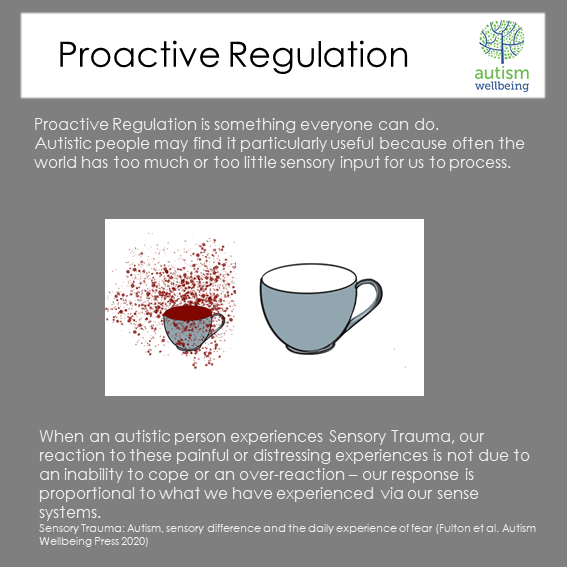
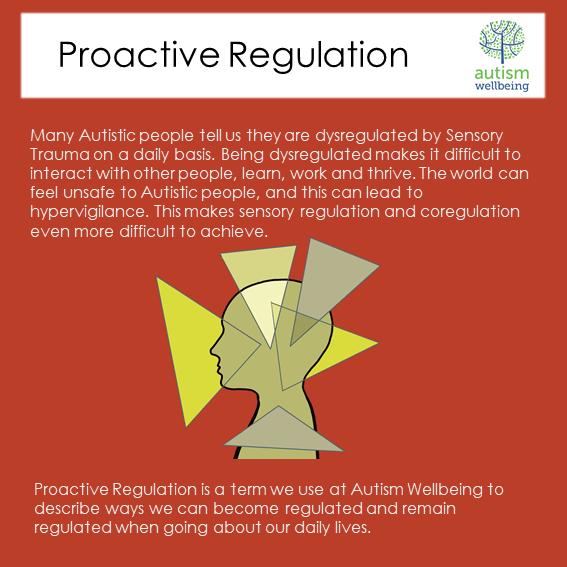
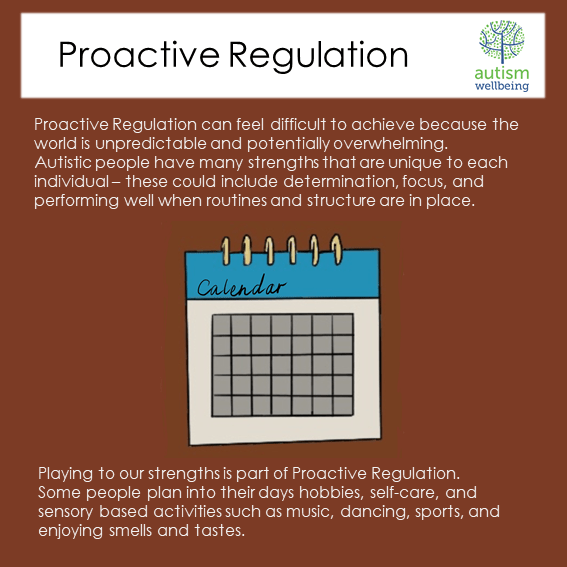
Mostly, when I feel distressed these days, I automatically see it as a cue to do some self-care, show myself compassion, and regulate myself. I even feel able to reach out to others that I trust. Here are some infographics about proactive regulation. It is important to be regulated before you need to be, in fact you can stockpile regulating sensory input for later. Just as I described feeling the distressing effects of the school bell hours later, or hearing “echoes” of previous conversations in my quiet moments, I can feel the positive effects of regulating input hours later too. Proactive regulation has been a game changer for me.

Thank you for reading this blog. I was unsure about whether to add trigger warnings as what triggers each of us may be different. Even trigger warnings can be triggering! This blog is one of positive change and hope. If you need help with difficult and distressing feelings raised by this blog, please reach out to someone or contact the Samaritans or other organisations.

Categories
Uncategorized

Why I love motorcycling…

Riding back over the mountain earlier, a pair of Red Kites swooped down low in tandem in front of me and majestically soared back up high into the bright blue sky. I was close enough to see their individual talons and notice whether either had a tag on its wings. There is something about the solitude of motorcycling and being in the scene rather than observing it from behind a windscreen that makes my heart soar, like those Kites, every time I ride.

Not one of the Kites I saw on my ride today, but one from at home in my village. I have written about Red Kites in my wildlife blog http://www.offdowntherabbithole.org

My love of biking was sparked as a child. I spent those long school summer holidays wandering around on my own, down on the beach or in the park; or maybe I’d cycle the 15 mile round trip on my pushbike, to Brean Down, a local beauty spot sticking out into the Bristol Channel. I’d climb along  to the old fort where I could hide and watch the rabbits and avoid the wild goats! (wild? – these were genuinely absolutely livid, and I felt like I took my life in my hands every time I ran the gauntlet through these hairy, horned, feral beasts). I’d make sure I was home in time for ‘Junior Kickstart’ though. This was a 1980’s British TV show and an offshoot of Kick Start – a televised trials bike competition where competitors would skilfully make  their way around and over various obstacles as quickly as possible without touching them, knocking them over or putting their feet down. I can still sing the theme tune 30+ years later – along with the revving engine noise at the end!

I had to make do with bicycling when I was young. We lived in a semi-detached house in a town and there was nowhere to ride an off-road bike. And furthermore, it would not have happened because I was a girl. I wasn’t a typical girl mind. I asked my mum what I was like because I know I never played with dolls or wanted other popular 1980’s girls toys, like a ‘Girls’ World’ – in fact I found the idea of having a severed head (albeit a plastic one) in my bedroom that I could apply make up to and do its hair, quite repulsive. I did have a Cindy doll – I cut its hair off and knitted it some survival clothes for having outdoor adventures in, like being lost in a jungle or stranded on a desert island. My favourite things, according to my mum, and she was absolutely spot on; were reading and cycling. I would get on my bicycle and disappear off for as long as possible, not considering the fear I instilled in her by cheerily recounting how I’d cycled to the next town along the main road and then climbed a hill or gone looking for creatures in the sand dunes. I was an extremely accident-prone child and had a tendency to go off in pursuit of whatever it was that took my fancy that day, with no consideration for safety or telling someone. There was no way I was having a motorbike.

I had my first ride as a pillion passenger on a family friend’s motorbike. I remember how it felt sitting on the back and the pull of the various forces working on my body as we accelerated. I knew at that moment; I would have to have my own motorbike someday. It was all the fun of bicycling but with this added ‘something’.

When I was 18, I bought a moped. An orange Suzuki FZ50. I lived in a town near the Quantock hills and I’d ride up there and wander around, enjoying the solitude away from the busy streets and the flats where I lived. I loaned that bike to a ‘friend’ – well it was someone who lived in the flats who I hung out with. They disappeared off on my bike and I eventually found it dumped and broken. I saved up and bought a Honda step-through – one of the most popular motorcycles in the world ever. The classic C90 in red, with fairing, top box, leg shields – the full works. This bike wasn’t a ‘twist and go’ like the moped,  but had 3 semi-automatic gears where you pushed the gear pedal to engage in a gear but without the need to hand operate a clutch lever. I used this bike for my daily commute to college and it ate up the 13 mile journey easily. However, I had decided that travelling to Taunton every day was tiresome and I was offered a room in a shared house belonging to someone on my course and I moved in. I was riding back to my new pad one evening and a young man shot through a red light and I hit the side of his car at 30mph and tumbled over his bonnet onto the road. We agreed to settle this privately and he gave me enough cash to buy my first proper motorbike; with manual gears, a kick start, and trail bike styling – I was about to realise my ‘Junior Kick Start’ dream with Honda’s XL100.

Up until this point, I had motorcycled alone, much like I did most things in life. One night in January 1994, with my arm in a sling from the aforementioned accident, I turned up at a friends’ house. John, Chris and Matt were guys I knew from my old town and had also moved to Taunton and were at the college, and they had planned a night out. Did I want to come along? I decided to give it a try and when I arrived I found that everyone had brought something to drink before heading for town. I’ve never been good at ‘getting’ this type of social etiquette and I looked around the room and asked whether anyone wanted to go halves with me on a bottle of red wine from the off-licence. This one guy said he did and we went off in search of alcohol. He asked me about my injury and we got talking about motorbikes and never really stopped talking about them for the following 27 years we spent together.

I hadn’t taken my bike test at this point because I had a full car licence and you could ride on L-plates with that. I decided to take  my CBT and test, and passed first time that April. My first ‘big’ bike was the little Kawasaki Z200, that I sprayed matt black. It was a lovely bike and took me on all sorts of camping trips and to rallies and eventually when I moved to Bristol for University, it lived in my front garden and was used for getting around the city. I used to ride to West Wales where my partner had gone to pursue his studies in Lampeter. I discovered the joy of having long rides – and my goodness, everything feels like a long ride on a Z200! I had read Robert M. Pirsig’s Zen and the Art of Motorcycle Maintenance and my head was filled with tales of the open road and philosophy. I still have a copy of this book on my bedside table and I’ve re-read it at various points on my life and I always find something new that resonates with me. Pirsig was an extremely intelligent, articulate man who experienced treatment with electroconvulsive therapy back in the 1960’s when he was diagnosed with schizophrenia. Every time I read his books (Lila: An Inquiry into Morals further explores the concept of quality started in Zen and the Art of Motorcycle Maintenance) I reflect on how similarly we see the world even though we are world’s apart. I would have loved to have a conversation with him about so many things – I’d love to know his thoughts on autism.

Although I enjoyed riding as a pillion passenger or having a try of friend’s bikes and riding along with them, I never fancied joining a club or gang. It wasn’t just my gender – although I must say, most images of biker girls do not show appropriate safety gear in my opinion! I have just never been part of any ‘scene’. When I moved to West Wales there was quite a few bikers. Lots of students, a local MAG (motorcycle action group), a back-patch club on the coast and a NCC (National Chopper Club). There was a MCC around Lampeter at that time but I’ve always been put off joining any clubs. The back-patch MC clubs are generally male only (there are a couple of female MC’s) and the MCC’s have never appealed either. I rode around and lived a simple life and I hung out with other people occasionally and life was good. I had spent a good few years by this time with only two-wheeled transport. I had a full car licence but no car and I rode my motorbike day in, day out. Whatever the weather and wherever I needed to. I rented a converted barn in the middle of nowhere and had no electricity and only spring water. There was no road and the track was just about passable, and allowed me another taste of my ‘Junior Kickstart’ trials riding experiences. My favourite ride was over the hills to Lampeter and on a fine day I’d take off my helmet and ride along the ancient roadway, wind in my hair and a song in my heart.

I’ve never been one for fashion or dressing up, and motorcycling suited me for that reason too. I wore my bike gear all the time. No tough decisions on what to wear each day, no not knowing whether I felt comfy or not – I was always comfortable, my bike gear moulded to fit me and didn’t have to be washed so never smelt ‘wrong’ or felt itchy. It also suited living in a barn with no electricity where we relied on a rayburn and gas lights and candles. I’d ride to town and carry home a week’s worth of shopping in my panniers and rucksack, and strap a sack of coal across the saddle.

1994 on my Kawasaki Z200. I rode in all weathers, hence the ex-army parka

I opened by describing how being ‘in the scene’ rather than observing, was so important to me. Thank Robert M. Pirsig for that one. Riding a motorcycle is an incredibly ‘in the moment’ type activity. I have practiced mindfulness for a long time, and had an interest in meditation, and philosophy, and science for even longer. When I ride, I can only think about the present: I can wonder, and explore ideas, and contemplate and muse; but I rarely reminisce, or worry, or replay past events or plan for the future. You have to be present because you are on two wheels and travelling at speeds of up to 70 mph (or whatever the legal limit is). If you are not totally and utterly focussed, it is likely you will have an accident. Plus, why would you want to miss a single minute of that wonderful feeling?

So what is it that is so fantastic about biking? For me it’s not the lifestyle, I’ve never been one for conforming to any type. Although, the camaraderie is like nothing else. This morning I know that every biker that raised their hand to acknowledge me, had that look in their eye, and probably a smile on their lips that said “This is fantastic isn’t it?!” I’ve always felt accepted by other bikers, my autism doesn’t even seem to register because it’s about what we have in common not what our differences are. I’ve met lots of different people who ride bikes and I’d say that many of them would be seen as eccentric or non-conformist. It’s fine to meet a biker you have never met before and launch into an enthusiastic tirade about your ride, or their bike, or ‘did you just see that idiot pull out in the Volvo?, or even the cake you just had with your cup of tea. Small talk doesn’t seem necessary and this aspect of biking has always appealed to me too.

The most significant part of biking now makes more sense to me. I’ve always recognised there was ‘something’ going on, on that very first ride as a pillion passenger. Motorcycling affects every one of my senses in a most intense way. It is the most holistically satisfying activity ever. It regulates my emotions and senses like nothing else. Harley Davidson and the UCL have recently conducted scientific research into the mental health impact of motorcycling and the findings showed that the benefits are more like those of exercise (reduction in stress hormones etc), rather than being similar to having a drive in a car. Any biker could have told you this! I’ll describe how motorbiking effects my senses:

Vision: There are so many styles of motorcycle to choose from. I’ve owned and ridden all sorts, the machines I’ve described in this blog and many more besides. I do like a trail type bike personally. I like to sit upright and be high up and get a good view over the hedges. My latest bike is an Aprilia Pegaso Strada – a kind of adventure bike machine. Bikes are beautiful to look at and Mal and I sat just staring at his Enfield bullet and it’s wonderful mechanical simplicity and style.

Smell: Who doesn’t love that smell of hot engine, petrol and oil? It is the most satisfying smell to open your garage door to.

Auditory: I love a big single cylinder engine. I had an XBR500 café racer style Honda before the Aprilia and that too had a wonderful slow, deep, thump of a big single cylinder motor.

Touch: The feel of wearing clothing that is solid, fits well and has no fancy bits to irritate me is great. I love the sensation of sitting on the bike and being able to feel things with the extremities of my body. The clunk of the gear pedal, the twist of the throttle and the wind in my face.

Taste: It isn’t a proper ride out if you don’t have chips or a cup of tea and cake! I could write a book called ‘Around Britain by cake’. Whenever I recount a past ride-out I’ll always remember where we stopped and what we had to eat there. Food just tastes so much better when your senses are switched on by the joy of riding.

The next 3 senses are the ones less discussed outside of autism circles. These are the important ones for me though when it comes to motorcycling:

Vestibular: This is the sense of where your body is in relation to gravity. This is the sense that biking really excites in me. I like speed but I prefer acceleration. That pull and push of speeding away from a standing start just gets me going every time. When I am moving, my clumsiness disappears, and I can judge speed and distance in a way I just can’t when not on the bike. The forces working on my body as I travel switch something on in me that lasts much longer than the ride itself.

Proprioception: I mentioned my clumsiness and if you saw me off the bike you’d probably advise me that motorcycling is not for me! The clothing helps give me a sense of where my body is in relation to itself. I feel sensations in  parts of me that I didn’t know existed otherwise. Having recently taken up riding again after a break, I realised that the vibration of riding and the repetitive movement of using my hands on the clutch and brake levers give me a sense of where my forearms are. I’d forgotten I had forearms to be honest and I frequently have bruises around my wrists where I knock things because I don’t notice in time. I need to put a lot of movement into my arms to notice them – I wonder whether that is why certain repetitive movements involving shaking or flapping your arms are so common in autistic people? The vibration (that favourite big single-cylinder engine again) gives me a sensation throughout my body. It’s neither pleasurable nor uncomfortable, it just seems to vibrate everything awake and I know where my body is for ages after a ride. I have certainly been less clumsy during those periods in  my life where I rode daily.

Interoception: This is the sense of knowing what you feel – whether that is bodily functions like being hungry or your emotions. I have weak interoception and motorbiking awakens a pleasant feeling in me. It’s not a strong emotion, it’s more an inner peace where I know I’m ok, I know I’m contented and I know that I am part of the world.

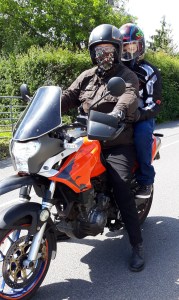
This is me earlier this week with our son riding pillion. He is 14 and has an off-road bike he is learning to fix and ride.